CAS 2696-84-6
:4-Propylaniline
Description:
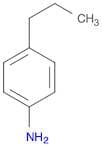
4-Propylaniline, also known as para-propylaniline, is an organic compound characterized by the presence of an aniline group (an amino group attached to a benzene ring) with a propyl substituent at the para position. Its molecular formula is C10H15N, indicating it consists of ten carbon atoms, fifteen hydrogen atoms, and one nitrogen atom. This compound typically appears as a colorless to pale yellow liquid and has a distinct amine-like odor. 4-Propylaniline is soluble in organic solvents but has limited solubility in water due to its hydrophobic propyl group. It is primarily used in the synthesis of dyes, pharmaceuticals, and agrochemicals. The compound can undergo typical reactions of amines, such as alkylation and acylation, and may also participate in electrophilic aromatic substitution due to the electron-donating nature of the amino group. Safety precautions should be taken when handling 4-propylaniline, as it may pose health risks, including skin and respiratory irritation.
Formula:C9H13N
InChI:InChI=1S/C9H13N/c1-2-3-8-4-6-9(10)7-5-8/h4-7H,2-3,10H2,1H3
InChI key:InChIKey=OAPDPORYXWQVJE-UHFFFAOYSA-N
SMILES:C(CC)C1=CC=C(N)C=C1
Synonyms:- (4-Propylphenyl)amine
- 1-Amino-4-propylbenzene
- 4-Propylbenzenamine
- 4-n-Propylaniline
- Aniline, 4-propyl-
- Aniline, p-propyl-
- Benzenamine, 4-propyl-
- Brn 2205524
- Nsc 13208
- p-Aminopropylbenzene
- p-Propylaminobenzene
- p-Propylaniline
- p-n-Propylaniline
- 4-Propylaniline
- See more synonyms
Sort by
Purity (%)
0
100
|
0
|
50
|
90
|
95
|
100
Found 4 products.
4-Propylaniline
CAS:4-Propylaniline is a monosubstituted aromatic amine. It is used in the synthesis of other compounds, such as 4-propylpyridine and 4-chloropyridine. It is also used in the production of polymers, agricultural chemicals, and pharmaceuticals. The functional groups present in this compound are amines and anilines. Hydrophilic compounds like this one are soluble in water, making it easier for cells to absorb them. These molecules are homologous with other molecules found in nature, such as spermine synthase or linear regression analysis. The optical properties of this molecule can be changed by substituting some of its hydrogen atoms with deuterium atoms.
Formula:C9H13NPurity:Min. 95%Color and Shape:Clear Colourless To Yellow To Red To Tan To Brown LiquidMolecular weight:135.21 g/mol