CAS 27006-82-2
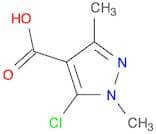
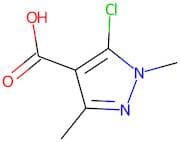
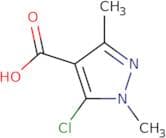
:5-chloro-1,3-dimethyl-1H-pyrazole-4-carboxylic acid
Description:
5-Chloro-1,3-dimethyl-1H-pyrazole-4-carboxylic acid is a heterocyclic organic compound characterized by its pyrazole ring structure, which includes a chlorine substituent and two methyl groups. This compound features a carboxylic acid functional group, contributing to its acidic properties. The presence of the chlorine atom enhances its reactivity and may influence its biological activity, making it of interest in various chemical and pharmaceutical applications. The dimethyl groups provide steric hindrance, which can affect the compound's interactions with other molecules. Typically, compounds like this are studied for their potential use in agrochemicals, pharmaceuticals, or as intermediates in organic synthesis. Its solubility and stability can vary depending on the solvent and environmental conditions, which are important factors for its practical applications. Overall, 5-chloro-1,3-dimethyl-1H-pyrazole-4-carboxylic acid is a versatile compound with notable characteristics that make it significant in both research and industrial contexts.
Formula:C6H7ClN2O2
InChI:InChI=1/C6H7ClN2O2/c1-3-4(6(10)11)5(7)9(2)8-3/h1-2H3,(H,10,11)
SMILES:Cc1c(c(Cl)n(C)n1)C(=O)O
Sort by
Purity (%)
0
100
|
0
|
50
|
90
|
95
|
100
Found 4 products.
5-Chloro-1,3-Dimethyl-1H-Pyrazole-4-Carboxylic Acid
CAS:Formula:C6H7ClN2O2Purity:95%Color and Shape:SolidMolecular weight:174.58505-Chloro-1,3-dimethyl-1H-pyrazole-4-carboxylic acid
CAS:5-Chloro-1,3-dimethyl-1H-pyrazole-4-carboxylic acidPurity:≥95%Molecular weight:174.58g/mol5-Chloro-1,3-dimethyl-1H-pyrazole-4-carboxylic acid
CAS:Formula:C6H7ClN2O2Purity:95%Color and Shape:SolidMolecular weight:174.585-Chloro-1,3-dimethyl-1H-pyrazole-4-carboxylic acid
CAS:5-Chloro-1,3-dimethyl-1H-pyrazole-4-carboxylic acid (DMPC) is a reactive compound that has been shown to be optically active. DMPC is found in plants and is used as an antiseptic and germicide. It is also used as an ingredient in horticultural products. The chloro group on the DMPC molecule can react with other compounds, such as chloride ions, to form a chlorinated derivative which exhibits increased antibacterial activity. This increased antibacterial activity may be due to the fact that the chlorine atom in DMPC reacts with bacterial cell membranes, making them more permeable and leading to cell death.
Formula:C6H7ClN2O2Purity:Min. 95%Molecular weight:174.59 g/mol