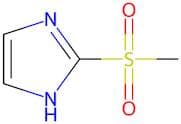
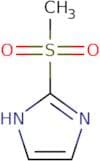
CAS 27098-98-2
:2-(methylsulfonyl)-1H-imidazole
Description:
2-(Methylsulfonyl)-1H-imidazole is an organic compound characterized by its imidazole ring, which is a five-membered heterocyclic structure containing two nitrogen atoms. This compound features a methylsulfonyl group (-SO2CH3) attached to the imidazole, which contributes to its unique chemical properties. It is typically a white to off-white solid and is soluble in polar solvents due to the presence of the sulfonyl group, which enhances its polarity. The compound exhibits potential biological activity, making it of interest in pharmaceutical research, particularly in the development of drugs targeting various diseases. Its structure allows for hydrogen bonding and interactions with biological macromolecules, which can influence its reactivity and biological efficacy. Additionally, 2-(methylsulfonyl)-1H-imidazole may participate in various chemical reactions, including nucleophilic substitutions and electrophilic additions, due to the presence of functional groups that can act as both nucleophiles and electrophiles. Overall, this compound's unique structure and properties make it a subject of interest in both synthetic and medicinal chemistry.
Formula:C4H6N2O2S
InChI:InChI=1/C4H6N2O2S/c1-9(7,8)4-5-2-3-6-4/h2-3H,1H3,(H,5,6)
SMILES:CS(=O)(=O)c1ncc[nH]1
Synonyms:- 1H-imidazole, 2-(methylsulfonyl)-
- 2-(Methylsulfonyl)-1H-imidazole
Sort by
Purity (%)
0
100
|
0
|
50
|
90
|
95
|
100
Found 4 products.
2-Methanesulfonyl-1H-imidazole
CAS:2-Methanesulfonyl-1H-imidazole (MSI) is a sulphydryl containing compound that has been shown to be an electron-withdrawing group. It has shown to be cytotoxic in the chinese hamster cell line and radiosensitizes cells in culture. MSI also inhibits oxidative phosphorylation by inhibiting enzymes such as eukaryotic cytochrome c oxidase, succinate dehydrogenase, and adenylate kinase. MSI is also effective against E. coli and other bacteria, including mycobacterium tuberculosis. MSI may be cytotoxic due to its ability to inhibit bacterial DNA synthesis by preventing deoxyribonucleotide synthesis and the inhibition of RNA synthesis.Formula:C4H6N2O2SPurity:Min. 95%Molecular weight:146.17 g/mol