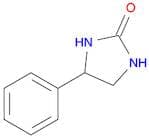
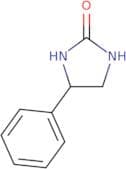
CAS 27129-49-3
:4-phenylimidazolidin-2-one
Description:
4-Phenylimidazolidin-2-one, with the CAS number 27129-49-3, is a heterocyclic organic compound characterized by its imidazolidinone structure, which features a five-membered ring containing two nitrogen atoms and a carbonyl group. This compound typically exhibits a white to off-white crystalline appearance and is soluble in polar solvents, such as water and alcohols, due to the presence of polar functional groups. It is known for its potential applications in medicinal chemistry, particularly as a building block in the synthesis of various pharmaceuticals and biologically active compounds. The presence of the phenyl group enhances its chemical reactivity and may influence its biological activity. Additionally, 4-phenylimidazolidin-2-one may exhibit properties such as moderate stability under standard conditions, but it can be sensitive to heat and light, which may affect its integrity. As with many organic compounds, safety precautions should be taken when handling it, as it may pose health risks if ingested or inhaled.
Formula:C9H10N2O
InChI:InChI=1/C9H10N2O/c12-9-10-6-8(11-9)7-4-2-1-3-5-7/h1-5,8H,6H2,(H2,10,11,12)
SMILES:c1ccc(cc1)C1CN=C(N1)O
Sort by
Purity (%)
0
100
|
0
|
50
|
90
|
95
|
100
Found 2 products.
4-Phenylimidazolidin-2-one
CAS:4-Phenylimidazolidin-2-one is a prodrug that is converted to an active form by hydrolysis. This compound has antiviral potency and a detection time of 1 to 4 hours. 4-Phenylimidazolidin-2-one is used as an antiviral agent for the treatment of influenza A and B. It also has anticancer activity, which may be due to its ability to inhibit allosteric binding sites on proteins such as human epidermal growth factor receptor 2 (HER2) and vascular endothelial growth factor receptor 2 (VEGFR2). It has been shown to be effective against cancer cells in vitro and in vivo, including the highly aggressive tumor cell line sw620. The mechanism of action for the anticancer activity of 4-phenylimidazolidin-2-one may be through the inhibition of protein kinase C (PKC) and phospholipase C (PLC), which areFormula:C9H10N2OPurity:Min. 95%Molecular weight:162.19 g/mol