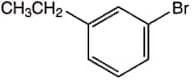
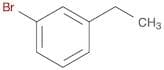
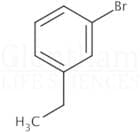
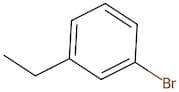
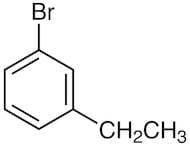
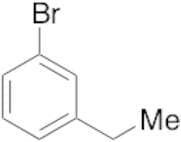
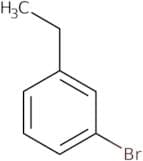
CAS 2725-82-8
:1-Bromo-3-ethylbenzene
- (3-Ethylphenyl)bromide
- 1-Ethyl-3-bromobenzene
- 3-Bromo-1-ethylbenzene
- 3-Bromoethylbenzene
- 3-Ethylbromobenzene
- Benzene, 1-bromo-3-ethyl-
- m-Bromoethylbenzene
- m-Ethylbromobenzene
1-Bromo-3-ethylbenzene, 98%
CAS:This Thermo Scientific Chemicals brand product was originally part of the Alfa Aesar product portfolio. Some documentation and label information may refer to the legacy brand. The original Alfa Aesar product / item code or SKU reference has not changed as a part of the brand transition to Thermo SciFormula:C8H9BrPurity:98%Color and Shape:Clear colorless, LiquidMolecular weight:185.061-Bromo-3-ethylbenzene
CAS:1-Bromo-3-ethylbenzeneFormula:C8H9BrPurity:98%Color and Shape: light brown liquidMolecular weight:185.06g/mol1-Bromo-3-ethylbenzene
CAS:Formula:C8H9BrPurity:>98.0%(GC)Color and Shape:Colorless to Light yellow clear liquidMolecular weight:185.061-Bromo-3-ethylbenzene
CAS:Controlled ProductApplications 1-Bromo-3-ethylbenzene is a useful synthetic intermediate. 1-Bromo-3-ethylbenzene is also used as a reagent to synthesize novel benzo[1,4]diazepin-2-one derivatives, which act as Endothelin receptor agonists and can possibly be used to reduce arterial blood pressure in humans.
References Bolli, M., et al.: J. Med. Chem., 47, 2776 (2004)Formula:C8H9BrColor and Shape:NeatMolecular weight:185.061-Bromo-3-ethylbenzene
CAS:1-Bromo-3-ethylbenzene (1BEB) is a trifluoroacetic acid that is used as a reagent in the analysis of urine samples. It reacts with glutathione to form a fluorescent product, which can be detected by fluorescence spectroscopy. 1BEB reacts with methyl groups in the sample to produce an intermediate compound that can be measured by liquid chromatography-mass spectrometry (LC/MS). The reaction time for this process depends on the temperature and other conditions such as pH. LC/MS has been shown to be more accurate than kinetic measurements for the determination of 1BEB concentrations in urine because it takes into account the chemical reactions that take place during the analysis. In addition, methylbenzenes are also formed during this process, which can be analysed using gas chromatography-mass spectrometry (GC/MS). GC/MS has been shown to be more accurate than LC/MS methods for evaluating
Formula:C8H9BrPurity:Min. 95%Molecular weight:185.06 g/mol