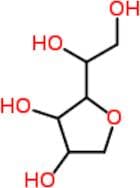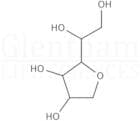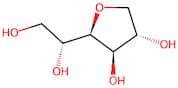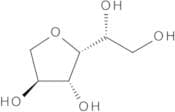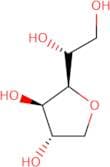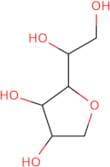
CAS 27299-12-3
:1,4-Sorbitan
- 1,4-Anhydro-<span class="text-smallcaps">D</span>-glucitol
- 1,4-Anhydro-<span class="text-smallcaps">D</span>-sorbitol
- 1,4-Anhydroglucitol
- 1,4-Sorbitan
- <span class="text-smallcaps">D</span>-Glucitol, 1,4-anhydro-
- Arlitan
- Glucitol, 1,4-anhydro-, <span class="text-smallcaps">D</span>-
- Unii-Av0Ytz4E6J
- 1,4-Anhydro-D-glucitol
- Glucitol, 1,4-anhydro-, D-
- D-Glucitol, 1,4-anhydro-
1,4-Sorbitan
CAS:Compounds containing an unfused furan ring (whether or not hydrogenated) in the structure nesoiFormula:C6H12O5Color and Shape:White Crystalline PowderMolecular weight:164.068471,4-Anhydro-D-sorbitol
CAS:Controlled ProductApplications A useful intermediate in Prostaglandin synthesis.
Not a dangerous good if item is equal to or less than 1g/ml and there is less than 100g/ml in the package
References Jeong, G., et al.: App. Biochem. Biotechnol., 137, 935 (2007),Formula:C6H12O5Color and Shape:White To Off-WhiteMolecular weight:164.161,4-Anhydro-D-glucitol
CAS:Intermediate in the synthesis of prostaglandins
Formula:C6H12O5Purity:Min. 97 Area-%Color and Shape:White Off-White PowderMolecular weight:164.16 g/mol1,4-Anhydro-D-glucitol
CAS:1,4-Anhydro-D-glucitol is a compound that belongs to the group of monosaccharides and has biological properties. It has also been used in the production of acetate extracts from fetal bovine erythrocytes. The ester linkages are formed between 1,4-anhydro-D-glucitol and sodium salt by reaction with acetic anhydride. The reaction mechanism has been studied in detail, and it was found that hydroxyl groups on the molecule react with sodium ions to form an ester linkage. This compound is toxicologically safe at high doses, but can become toxic at lower doses due to its acid formation potential.
Formula:C6H12O5Purity:Min. 97.0 Area-%Molecular weight:164.16 g/mol