CAS 27330-34-3
:2-Pyridinecarboxamide,3-amino-5-chloro-
Description:
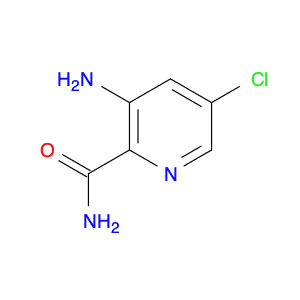
2-Pyridinecarboxamide, 3-amino-5-chloro- is an organic compound characterized by its pyridine ring structure, which is a six-membered aromatic ring containing one nitrogen atom. This compound features a carboxamide functional group (-C(=O)NH2) attached to the pyridine ring, along with an amino group (-NH2) and a chlorine substituent at specific positions on the ring. The presence of these functional groups contributes to its potential biological activity and solubility properties. Typically, compounds like this may exhibit polar characteristics due to the amide and amino groups, influencing their interactions in biological systems. The chlorine atom can also affect the compound's reactivity and stability. This substance may be of interest in medicinal chemistry and pharmaceutical research, particularly for its potential applications in drug development or as a biochemical probe. As with many organic compounds, its properties, such as melting point, boiling point, and solubility, would depend on the specific molecular interactions and the environment in which it is studied.
Formula:C6H6ClN3O
Synonyms:- Picolinamide,3-amino-5-chloro- (8CI)
Sort by
Purity (%)
0
100
|
0
|
50
|
90
|
95
|
100
Found 4 products.
3-AMINO-5-CHLOROPYRIDINE-2-CARBOXAMIDE
CAS:Formula:C6H6ClN3OPurity:95%Color and Shape:SolidMolecular weight:171.58433-Amino-5-chloropyridine-2-carboxamide
CAS:Formula:C6H6ClN3OPurity:95%Color and Shape:SolidMolecular weight:171.583-Amino-5-chloropyridine-2-carboxamide
CAS:3-Amino-5-chloropyridine-2-carboxamide is a phosphoinositide (PI) analog that has been shown to inhibit the growth of cancer cells. It also inhibits the production of proteins, such as cyclin D1 and Bcl-xL, which are required for cancer cell proliferation. 3-Amino-5-chloropyridine-2-carboxamide has been shown to be effective in vivo in animal models and in vitro in human cancer cells. The compound has been shown to have no effect on normal cells, leading to a low level of toxicity. This drug can be used as an anticancer agent or as part of a combined therapy regimen with other chemotherapeutic agents.
Formula:C6H6ClN3OPurity:Min. 95%Molecular weight:171.58 g/mol