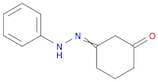
CAS 27385-45-1
:1,3-Cyclohexanedione, 1-(2-phenylhydrazone)
Description:
1,3-Cyclohexanedione, 1-(2-phenylhydrazone) is an organic compound characterized by its hydrazone functional group, which is formed from the reaction of 1,3-cyclohexanedione with phenylhydrazine. This compound typically appears as a solid and is known for its potential applications in organic synthesis and as a reagent in various chemical reactions. It features a cyclohexane ring with two ketone groups at the 1 and 3 positions, contributing to its reactivity and ability to form derivatives. The presence of the phenylhydrazone moiety enhances its properties, making it useful in the development of dyes and pharmaceuticals. Additionally, this compound may exhibit specific optical properties due to its structural configuration, which can be exploited in analytical chemistry. As with many organic compounds, it is important to handle it with care, considering its potential reactivity and the need for proper safety protocols during use.
Formula:C12H14N2O
InChI:InChI=1S/C12H14N2O/c15-12-8-4-7-11(9-12)14-13-10-5-2-1-3-6-10/h1-3,5-6,13H,4,7-9H2
InChI key:InChIKey=ASBKHKGFGCNQJB-UHFFFAOYSA-N
SMILES:N(NC1=CC=CC=C1)=C2CC(=O)CCC2
Synonyms:- 1,3-Cyclohexanedione, 1-(2-phenylhydrazone)
- 1,3-Cyclohexanedione, mono(phenylhydrazone)
Sort by
Purity (%)
0
100
|
0
|
50
|
90
|
95
|
100
Found 3 products.
3-(2-phenylhydrazin-1-ylidene)cyclohexan-1-one
CAS:Formula:C12H14N2OPurity:95%Color and Shape:SolidMolecular weight:202.2524(Z)-3-(2-Phenylhydrazono)cyclohexanone
CAS:The method involves refluxing ethanol with a solid acid catalyst and a condensation agent. The reaction is catalyzed by the acid catalyst, which can be either an inorganic or organic acid. The reaction time is typically 3 to 4 hours. Effective catalysts include aluminum chloride, zinc chloride, and titanium tetrachloride. Carvedilol is an effective product of this reaction because it has a high yield and a low production cost. Solid-acid catalysts are used for this synthesis because they have excellent stability in the presence of water and air and can be easily recovered from the reaction mixture. The reactants are heated at reflux until the desired product is formed. This process is typically carried out using a reflux apparatus equipped with an efficient condenser and an ice bath to maintain the temperature below boiling point. The yields of the desired product are typically high, ranging from 80% to 95%.Formula:C12H14N2OPurity:Min. 95%Molecular weight:202.25 g/mol