CAS 27427-66-3
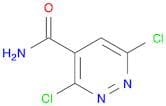
:3,6-dichloropyridazine-4-carboxamide
Description:
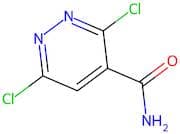
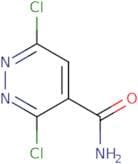
3,6-Dichloropyridazine-4-carboxamide is a chemical compound characterized by its pyridazine ring structure, which is a six-membered aromatic ring containing two nitrogen atoms at the 1 and 2 positions. The presence of two chlorine atoms at the 3 and 6 positions of the ring contributes to its reactivity and potential biological activity. The carboxamide functional group at the 4 position enhances its solubility in polar solvents and may influence its interaction with biological targets. This compound is typically used in research and development, particularly in the fields of medicinal chemistry and agrochemicals, due to its potential as a building block for more complex molecules. Its properties, such as melting point, boiling point, and solubility, can vary based on the specific conditions and purity of the sample. Safety data indicates that, like many chlorinated compounds, it should be handled with care, as it may pose environmental and health risks. Overall, 3,6-dichloropyridazine-4-carboxamide is a versatile compound with applications in various scientific fields.
Formula:C5H3Cl2N3O
InChI:InChI=1/C5H3Cl2N3O/c6-3-1-2(5(8)11)4(7)10-9-3/h1H,(H2,8,11)
SMILES:c1c(c(Cl)nnc1Cl)C(=N)O
Sort by
Purity (%)
0
100
|
0
|
50
|
90
|
95
|
100
Found 4 products.
3,6-Dichloropyridazine-4-carboxamide
CAS:Formula:C5H3Cl2N3OPurity:98%Color and Shape:SolidMolecular weight:192.00283,6-Dichloropyridazine-4-carboxamide
CAS:3,6-Dichloropyridazine-4-carboxamidePurity:98%Molecular weight:192.00g/mol3,6-Dichloropyridazine-4-carboxamide
CAS:3,6-Dichloropyridazine-4-carboxamide is a white crystalline substance that belongs to the group of pyridazine derivatives. It has been shown to have a high primary amine content and a crystal structure. 3,6-Dichloropyridazine-4-carboxamide was synthesized by reacting an anthranilic acid with 3,6-dichloropyridazine in dimethylformamide. Mechanistic studies have shown that this reaction product is formed through an initial hydride addition to the pyrazole ring followed by hydrolysis of the methyl ester and chloride ion substitution. The result of this reaction is an anthranilic acid derivative with chlorine substitutions at positions 3 and 6 on the pyridine ring.Formula:C5H3Cl2N3OPurity:Min. 95%Molecular weight:192 g/mol