CAS 27477-88-9
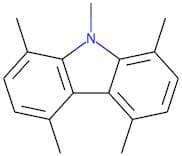
:1,4,5,8,9-pentamethylcarbazole
Description:
1,4,5,8,9-Pentamethylcarbazole is an organic compound belonging to the carbazole family, characterized by its polycyclic aromatic structure. It features a carbazole core with five methyl groups attached at the 1, 4, 5, 8, and 9 positions, which significantly influences its physical and chemical properties. This compound is typically a solid at room temperature and exhibits a relatively high melting point due to its stable aromatic structure. It is known for its fluorescence and potential applications in organic electronics, particularly in light-emitting diodes (LEDs) and organic photovoltaic cells. The presence of multiple methyl groups enhances its solubility in organic solvents while also affecting its electronic properties, making it a subject of interest in materials science. Additionally, 1,4,5,8,9-pentamethylcarbazole may exhibit interesting photophysical properties, including absorption and emission spectra that can be tuned by varying the substitution pattern or the environment. Safety data should be consulted for handling and exposure guidelines, as with any chemical substance.
Formula:C17H19N
InChI:InChI=1/C17H19N/c1-10-6-8-12(3)16-14(10)15-11(2)7-9-13(4)17(15)18(16)5/h6-9H,1-5H3
SMILES:Cc1ccc(C)c2c1c1c(C)ccc(C)c1n2C
Synonyms:- 1,4,5,8,9-pentamethyl-9H-carbazole
- 1,4,5,8,9-PENTAMETHYLCARBAZOLE
Sort by
Purity (%)
0
100
|
0
|
50
|
90
|
95
|
100
Found 2 products.
1,4,5,8,9-Pentamethylcarbazole
CAS:1,4,5,8,9-PentamethylcarbazolePurity:≥95%Molecular weight:237.34g/mol1,4,5,8,9-Pentamethylcarbazole
CAS:The 1,4,5,8,9-Pentamethylcarbazole (PMC) molecule is a modified aromatic compound. It is one of the most common modifiers in analytical chemistry due to its high electron density and chemical stability. The chloride anion can be introduced into the PMC molecule by reacting with chloroform in the presence of a strong base. This reaction produces the chloride-substituted PMC that has been shown to have increased electron density and lower redox potentials than unsubstituted PMC. The chloride ion may also be introduced into PMC molecules through oxidation with hypochlorite or hydrogen peroxide. The chloride-substituted PMC can also be used as a quencher for fluorescence exciplexes formed between guest molecules and oxalate esters. These interactions are dependent on solvent polarity and can be enhanced by adding a fatty acid to the mixture. Fluorescence measurements indicate that these interactions are relatively efficientFormula:C17H19NPurity:Min. 95%Color and Shape:PowderMolecular weight:237.34 g/mol