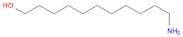
CAS 27780-89-8
:1-Undecanol, 11-amino-
Description:
1-Undecanol, 11-amino- is an organic compound characterized by its long hydrocarbon chain and the presence of an amino group. It belongs to the class of fatty alcohols, specifically a primary alcohol, due to the hydroxyl (-OH) group attached to the terminal carbon of an undecane chain. The amino group (-NH2) is located at the 11th carbon position, which influences its chemical reactivity and properties. This compound is typically a colorless to pale yellow liquid with a characteristic fatty odor. It is soluble in organic solvents but has limited solubility in water, reflecting its hydrophobic nature due to the long carbon chain. The presence of both the hydroxyl and amino groups allows for potential hydrogen bonding, which can affect its boiling point and melting point compared to other fatty alcohols. 1-Undecanol, 11-amino- may find applications in various fields, including surfactants, emulsifiers, and as intermediates in organic synthesis. Safety data should be consulted for handling and usage, as with all chemical substances.
Formula:C11H25NO
Sort by
Purity (%)
0
100
|
0
|
50
|
90
|
95
|
100
Found 3 products.
11-Aminoundecan-1-ol
CAS:<p>11-Aminoundecan-1-ol is a bifunctional molecule that binds to the receptor and stabilizes it. It can be used as an antimicrobial agent against human pathogens, such as HIV, by preventing the virus from attaching to cells. 11-Aminoundecan-1-ol also has activity against plant viruses. This compound is an anhydroglucose with hydroxamic acid groups that are responsible for its antiviral properties and also contains a particle with azide functionalities. 11-Aminoundecan-1-ol has shown efficacy in inhibiting the replication of human Herpes simplex virus types 1 and 2 (HSV) in vitro, which may be due to its ability to bind to the HSV glycoprotein B envelope protein GP2.<br>11-Aminoundecan-1-ol can also bind to the receptor lysine and stabilize it. This binding prevents azides from reacting with l</p>Formula:C11H25NOPurity:Min. 95%Molecular weight:187.32 g/mol