CAS 27848-81-3
:Propanoic acid, 2-hydroxy-, monolithium salt, (2R)-
Description:
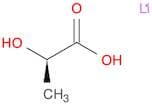
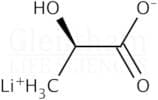
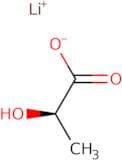
Propanoic acid, 2-hydroxy-, monolithium salt, (2R)-, also known as lithium 2-hydroxypropanoate, is a chemical compound characterized by its lithium salt form of 2-hydroxypropanoic acid (lactic acid). This compound typically appears as a white crystalline solid and is soluble in water due to the presence of the ionic lithium component. It exhibits properties typical of carboxylic acids, including the ability to donate protons (H+) in solution, although the presence of the lithium ion can influence its acidity and reactivity. The (2R)- designation indicates its specific stereochemistry, which can affect its biological activity and interactions. This compound is of interest in various fields, including biochemistry and pharmaceuticals, where it may play a role in metabolic processes or serve as a precursor in the synthesis of other compounds. Its stability, solubility, and reactivity make it a valuable substance in both research and industrial applications.
Formula:C3H6O3·Li
InChI:InChI=1S/C3H6O3.Li/c1-2(4)3(5)6;/h2,4H,1H3,(H,5,6);/t2-;/m1./s1
InChI key:InChIKey=MCPIIUKZBQXOSD-HSHFZTNMSA-N
SMILES:[C@H](C(O)=O)(C)O.[Li]
Synonyms:- <span class="text-smallcaps">D</span>-Lactic acid lithium salt
- Lactic acid, monolithium salt, <span class="text-smallcaps">D</span>-
- Lithium <span class="text-smallcaps">D</span>-lactate
- Propanoic acid, 2-hydroxy-, monolithium salt, (2R)-
- Propanoic acid, 2-hydroxy-, monolithium salt, (R)-
- lithium (2R)-2-hydroxypropanoate
- D-Lactic acid lithium salt
- Lithium D-(-)-lactate
- Lithium D-lactate
- Lactic acid, monolithium salt, D-
Sort by
Purity (%)
0
100
|
0
|
50
|
90
|
95
|
100
Found 4 products.
Lithium D-lactate
CAS:Formula:CH3CH(OH)CO2LiPurity:≥ 96.0%Color and Shape:White powderMolecular weight:96.01D-Lactic acid lithium
CAS:D(+)-Lactic acid lithium salt is a dipolar molecule with an activation energy of about 44 kJ/mol. It has been studied by NMR techniques and found to have a resonance in the range of 1.8-2.0 ppm, which is characteristic of protons on the oxygen atom. The proton magnetic resonance (PMR) study showed that the d-lactate resonances were very broad and shifted to higher frequencies, whereas the l-lactate resonances were sharp and shifted to lower frequencies. This may be due to the different number of protons on each type of lactate molecule. The magnetic resonance (NMR) study showed that lithium salt was a radical with a spin density distribution around 2.6 ppm in the nmr spectrum.
Formula:C3H6O3•LiPurity:Min. 95%Color and Shape:PowderMolecular weight:97.02 g/molRef: 3D-FF168657
Discontinued product