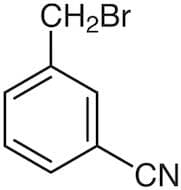
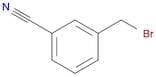
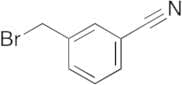
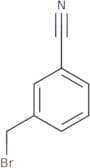
CAS 28188-41-2
:3-Cyanobenzyl bromide
- 1-Bromomethyl-3-cyanobenzene
- 2-BROMO-m-TOLUNITRILE
- 3-(Bromoethyl)benzonitrile
- 3-(Bromomethyl)benzonitrile
- 3-Cyanide Benzyl Bromide
- 3-Cyanobenzyl bromide
- Alpha-Bromo-M-Toluonitrile
- Alpha-Bromo-Meta-Tolunitrile
- Benzonitrile, 3-(bromomethyl)-
- NSC 108298
- Timtec-Bb Sbb007997
- m-(Bromomethyl)benzonitrile
- m-Cyano-α-bromotoluene
- m-Cyanobenzyl bromide
- m-Tolunitrile, α-bromo-
- See more synonyms
3-Bromomethylbenzonitrile
CAS:Formula:C8H6BrNPurity:>98.0%(GC)Color and Shape:White to Almost white powder to crystalineMolecular weight:196.053-(Bromomethyl)benzonitrile, 98%
CAS:This Thermo Scientific Chemicals brand product was originally part of the Alfa Aesar product portfolio. Some documentation and label information may refer to the legacy brand. The original Alfa Aesar product / item code or SKU reference has not changed as a part of the brand transition to Thermo SciFormula:C8H6BrNPurity:98%Color and Shape:White to cream, Crystals or powder or crystalline powderMolecular weight:196.053-(Bromomethyl)benzonitrile
CAS:Formula:C8H6BrNPurity:97%Color and Shape:SolidMolecular weight:196.0439α-Bromo-m-tolunitrile (3-(Bromomethyl)benzonitrile)
CAS:Formula:C8H6BrNPurity:(GC) ≥ 99.0%Color and Shape:Off-white crystalline powderMolecular weight:196.053-(Bromomethyl)benzonitrile
CAS:3-(Bromomethyl)benzonitrileFormula:C8H6BrNPurity:≥95%Color and Shape: off-white to faint orange crystalline powderMolecular weight:196.04g/mol3-Cyanobenzyl bromide
CAS:Formula:C8H6BrNPurity:97%Color and Shape:Beige powderMolecular weight:196.0473-Cyanobenzyl Bromide
CAS:Controlled ProductApplications 3-(Bromomethyl)benzonitrile is an intermediate used in the synthesis of 3-(bromomethyl)benzaldehyde. It also undergoes Suzuki cross-coupling reaction with bis(pinacolato)diboron.
Not a dangerous good if item is equal to or less than 1g/ml and there is less than 100g/ml in the package
References Gilday, L., et al.: Dalton Transactions, 41, 7092 (2012); Giroux, A.: Tetrahedron Lett., 44, 233 (2003)Formula:C8H6BrNColor and Shape:NeatMolecular weight:196.04alpha-Bromo-m-tolunitrile
CAS:Silver trifluoromethanesulfonate (AgOTf) is a precursor in the synthesis of alpha-bromo-m-tolunitrile. It is a colorless, odorless solid that can be prepared by the reaction of silver ions with bromine and toluene in an aqueous medium. The profile of AgOTf has been studied by titration method and it has been shown to have an oxadiazole group. This molecule also has anticancer activity against cancer cells. Alpha-Bromo-m-tolunitrile is currently being investigated for its potential use as a drug candidate for the treatment of cancer, with particular interest in the inhibition of angiogenesis and metastasis.
Formula:C8H6BrNPurity:Min. 95%Color and Shape:PowderMolecular weight:196.04 g/mol