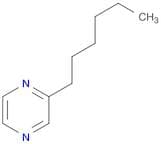
CAS 28217-91-6
:2-Hexylpyrazine
Description:
2-Hexylpyrazine is an organic compound characterized by its distinctive pyrazine ring structure, which is a six-membered aromatic ring containing two nitrogen atoms. This compound is known for its strong, earthy, and nutty aroma, making it of interest in the flavor and fragrance industries. It is a colorless to pale yellow liquid at room temperature and is soluble in organic solvents. The presence of the hexyl group contributes to its hydrophobic nature and influences its volatility and sensory properties. 2-Hexylpyrazine is often used as a flavoring agent in food products, particularly in savory applications, and can also be found in certain natural sources, such as roasted coffee and various nuts. Its chemical behavior is typical of pyrazines, exhibiting stability under normal conditions but may undergo reactions typical of aliphatic amines and aromatic compounds under specific circumstances. Safety data indicates that while it is generally recognized as safe in low concentrations, handling should still follow standard safety protocols to avoid potential irritation or adverse effects.
Formula:C10H16N2
InChI:InChI=1S/C10H16N2/c1-2-3-4-5-6-10-9-11-7-8-12-10/h7-9H,2-6H2,1H3
InChI key:InChIKey=LZQRFVUKPVNFJO-UHFFFAOYSA-N
SMILES:C(CCCCC)C=1C=NC=CN1
Synonyms:- 2-(Hexyl)pyrazine
- 2-Hexylpyrazine
- Pyrazine, hexyl-
- hexyl pyrazine
- Pyrazine, 2-hexyl-
- pyrazine, 2-hexyl-
Sort by
Purity (%)
0
100
|
0
|
50
|
90
|
95
|
100
Found 2 products.
2-Hexylpyrazine
CAS:<p>2-Hexylpyrazine is a heterocyclic organic compound that belongs to the group of alkynyl pyrazines. It is used as a solid catalyst in organic reactions, such as methylation, esterification, and alkylation. 2-Hexylpyrazine has been shown to be effective for bowel disease and inflammatory bowel disease. It has also been shown to inhibit cancer cell growth and is being studied for its potential use in the treatment of autoimmune diseases. 2-Hexylpyrazine is metabolized by bile acids and inflammatory cells into a reactive species which activates G protein coupled receptors on the surface of cells, leading to increased chloride ion concentrations within the cell. This leads to inhibition of dopamine D3 receptor signaling, which may have anti-inflammatory effects.</p>Formula:C10H16N2Purity:Min. 95%Molecular weight:164.25 g/mol