CAS 28246-87-9
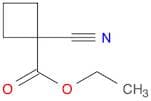
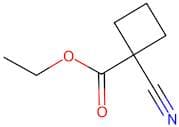
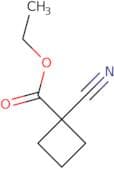
:ethyl 1-cyanocyclobutanecarboxylate
Description:
Ethyl 1-cyanocyclobutanecarboxylate, with the CAS number 28246-87-9, is an organic compound characterized by its unique structure that includes a cyclobutane ring, a cyano group, and an ester functional group. This compound typically appears as a colorless to pale yellow liquid and is known for its moderate volatility. Ethyl 1-cyanocyclobutanecarboxylate is soluble in organic solvents, which makes it useful in various chemical reactions and applications. The presence of the cyano group imparts notable reactivity, allowing for potential applications in synthetic organic chemistry, particularly in the formation of more complex molecules. Additionally, the ester functionality can participate in reactions such as hydrolysis and transesterification. Safety data indicates that, like many organic compounds, it should be handled with care, as it may pose health risks if inhaled or ingested. Overall, ethyl 1-cyanocyclobutanecarboxylate is a versatile compound with potential utility in both research and industrial applications.
Formula:C8H11NO2
InChI:InChI=1/C8H11NO2/c1-2-11-7(10)8(6-9)4-3-5-8/h2-5H2,1H3
Synonyms:- 1-Cyanocyclobutanecarboxylic acid ethyl ester
- Cyclobutanecarboxylic Acid, 1-Cyano-, Ethyl Ester
- Ethyl 1-cyanocyclobutanecarboxylate
Sort by
Purity (%)
0
100
|
0
|
50
|
90
|
95
|
100
Found 5 products.
Ethyl 1-cyanocyclobutanecarboxylate
CAS:Formula:C8H11NO2Purity:95%Color and Shape:LiquidMolecular weight:153.1784Ethyl 1-cyanocyclobutanecarboxylate
CAS:Ethyl 1-cyanocyclobutanecarboxylatePurity:97%Color and Shape:Yellow LiquidMolecular weight:153.18g/molEthyl 1-cyanocyclobutanecarboxylate
CAS:Ethyl 1-cyanocyclobutanecarboxylate is a cyclic molecule that belongs to the homologues of ethylene. This compound has been shown to react with carbanions in the presence of a base to form anionic initiator molecules. Ethyl 1-cyanocyclobutanecarboxylate can be used as an experimental monomer for ring-opening polymerization reactions, which are nonquantitative and may require temperatures as high as 110°C. The rate of these reactions is determined by the concentration of monomers, which should be made as monodisperse as possible.Formula:C8H11NO2Purity:Min. 95%Molecular weight:153.18 g/mol