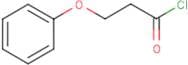
CAS 28317-96-6
:3-Phenoxypropanoyl chloride
Description:
3-Phenoxypropanoyl chloride, with the CAS number 28317-96-6, is an organic compound characterized by its acyl chloride functional group, which is derived from 3-phenoxypropanoic acid. This compound typically appears as a colorless to pale yellow liquid and is known for its reactivity, particularly in acylation reactions. It features a phenoxy group, which contributes to its aromatic properties, and a propanoyl moiety that enhances its utility in organic synthesis. The presence of the acyl chloride functional group makes it a potent electrophile, allowing it to readily react with nucleophiles, such as alcohols and amines, to form esters and amides, respectively. Due to its reactivity, 3-phenoxypropanoyl chloride must be handled with care, as it can be corrosive and may release hydrochloric acid upon hydrolysis. It is often used in the synthesis of various pharmaceuticals, agrochemicals, and other organic compounds, making it a valuable intermediate in chemical manufacturing. Proper safety precautions should be observed when working with this compound.
Formula:C9H9ClO2
InChI:InChI=1S/C9H9ClO2/c10-9(11)6-7-12-8-4-2-1-3-5-8/h1-5H,6-7H2
InChI key:InChIKey=SBSYFELXUYBRND-UHFFFAOYSA-N
SMILES:O(CCC(Cl)=O)C1=CC=CC=C1
Synonyms:- 3-Phenoxypropanoyl Chloride
- Propanoyl chloride, 3-phenoxy-
- Propionyl chloride, 3-phenoxy-
- 3-Phenoxypropionyl chloride
Sort by
Purity (%)
0
100
|
0
|
50
|
90
|
95
|
100
Found 2 products.
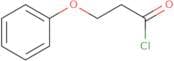
3-Phenoxypropanoyl chloride
CAS:3-Phenoxypropanoyl chloride is a phenoxy compound that is metabolized by the liver to form an amide. It has been shown to have therapeutic benefits in a variety of diseases, such as metabolic disorders, autoimmune diseases, cancers, and inflammatory diseases. 3-Phenoxypropanoyl chloride can be used for treating patients with autoimmune diseases and cancer due to its ability to inhibit the synthesis of cytokines and other mediators of inflammation. It also inhibits platelet aggregation at low doses, but has no effect on platelet function at higher doses. This drug is not active against gram-negative bacteria or fungi.
Formula:C9H9O2ClPurity:Min. 95%Molecular weight:184.61 g/molRef: 3D-DBA31796
Discontinued product