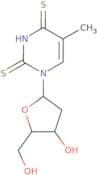
CAS 28585-52-6
:Thymidine, 2,4-dithio-
Description:
Thymidine, 2,4-dithio- is a chemical compound that belongs to the class of nucleosides, specifically a derivative of thymidine. It is characterized by the presence of two sulfur atoms in its structure, which are typically incorporated into the 2 and 4 positions of the thymidine molecule. This modification can influence its biological activity and stability. The compound is often studied for its potential applications in biochemistry and medicinal chemistry, particularly in the context of nucleic acid research and as a potential therapeutic agent. Thymidine derivatives are known to play roles in DNA synthesis and repair, and the introduction of dithio groups may enhance certain properties, such as reactivity or binding affinity to biological targets. The CAS number 28585-52-6 uniquely identifies this compound in chemical databases, facilitating its study and application in various scientific fields. As with many sulfur-containing compounds, it may exhibit distinct physical and chemical properties, including solubility and reactivity, which are important for its use in research and potential therapeutic applications.
Formula:C10H14N2O3S2
InChI:InChI=1S/C10H14N2O3S2/c1-5-3-12(10(17)11-9(5)16)8-2-6(14)7(4-13)15-8/h3,6-8,13-14H,2,4H2,1H3,(H,11,16,17)/t6-,7+,8+/m0/s1
InChI key:InChIKey=YWVRYVKUVBITIN-XLPZGREQSA-N
SMILES:S=C1N([C@@H]2O[C@H](CO)[C@@H](O)C2)C=C(C)C(=S)N1
Synonyms:- Thymidine, 2,4-dithio-
Sort by
Purity (%)
0
100
|
0
|
50
|
90
|
95
|
100
Found 1 products.
2,4-Dithiothymidine
CAS:<p>2,4-Dithiothymidine (DT) is a chemotherapeutic that has been shown to be clinically effective in the treatment of hematopoietic malignancies. It is an oligothymidylate analogue that contains a pyrimidine heterocycle and an ethylthio group. DT is not a nucleoside analog, but it inhibits DNA synthesis by binding to the enzyme thymidylate synthase and preventing the formation of thymine from uracil. DT also binds to single-stranded DNA with high affinity and alters its conformation, which may inhibit transcription and replication. The photophysical properties of this molecule are studied theoretically using quantum mechanics and population analysis theory. The reagent DT can be used to focus attention on other molecules or conformation states of proteins that might have improved biological activity.</p>Formula:C10H14N2O3S2Purity:Min. 95%Molecular weight:274.36 g/mol