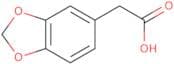
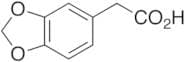
CAS 2861-28-1
:1,3-Benzodioxole-5-acetic acid
Description:
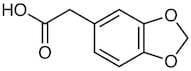
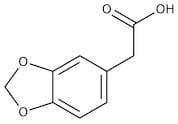
1,3-Benzodioxole-5-acetic acid, with the CAS number 2861-28-1, is an organic compound characterized by its unique bicyclic structure that includes a benzodioxole moiety and an acetic acid functional group. This compound typically appears as a white to off-white solid and is soluble in polar organic solvents. It exhibits properties associated with both aromatic compounds and carboxylic acids, which can influence its reactivity and interactions. The presence of the dioxole ring contributes to its stability and potential for forming hydrogen bonds, while the acetic acid group provides acidic characteristics. This compound may be of interest in various fields, including medicinal chemistry and materials science, due to its potential biological activities and applications in synthesizing other chemical entities. Additionally, its derivatives may exhibit diverse pharmacological properties, making it a subject of research in drug development. As with many organic compounds, proper handling and safety measures should be observed due to potential toxicity or reactivity.
Formula:C9H8O4
InChI:InChI=1S/C9H8O4/c10-9(11)4-6-1-2-7-8(3-6)13-5-12-7/h1-3H,4-5H2,(H,10,11)
InChI key:InChIKey=ODVLMCWNGKLROU-UHFFFAOYSA-N
SMILES:C(C(O)=O)C=1C=C2C(=CC1)OCO2
Synonyms:- (1,3-Benzodioxol-5-yl)acetic acid
- (1,3-Benzodioxol-5-yl)aceticacid
- (Benzodioxol-5-yl)acetic acid
- 1,3-Benzodioxol-5-Ylacetate
- 1,3-Benzodioxol-5-Ylacetic Acid
- 1,3-Benzodioxole-5-acetic acid
- 2-(1,3-Benzodioxol-5-yl)acetic acid
- 2-(1,3-Dioxaindan-5-yl)acetic acid
- 2-(2H-1,3-Benzodioxol-5-yl)acetic acid
- 2-(3,4-Methylenedioxyphenyl)acetic acid
- 2-(Benzo[d][1,3]dioxol-5-yl)acetic acid
- 2-(Benzodioxol-5-yl)acetic acid
- 3,4-(Methylenedioxy)benzene-1-acetic acid
- 3,4-(Methylenedioxy)phenylacetic acid
- 3,4-Methylendioxyphenylacetic acid
- Acetic acid, [3,4-(methylenedioxy)phenyl]-
- Ai3-19940
- Homopiperonylic acid
- NSC 119057
- NSC 14364
- See more synonyms
Sort by
Purity (%)
0
100
|
0
|
50
|
90
|
95
|
100
Found 6 products.
3,4-Methylenedioxyphenylacetic Acid
CAS:Formula:C9H8O4Purity:>98.0%(GC)(T)Color and Shape:White to Light yellow to Light orange powder to crystalMolecular weight:180.163,4-(Methylenedioxy)phenylacetic acid, 98%
CAS:3,4-(Methylenedioxy)phenylacetic acid is used as organic intermediates. This Thermo Scientific Chemicals brand product was originally part of the Alfa Aesar product portfolio. Some documentation and label information may refer to the legacy brand. The original Alfa Aesar product / item code or SKU rFormula:C9H8O4Purity:98%Color and Shape:White to cream to pale brown, Crystals or powder or crystalline powderMolecular weight:180.162-(Benzo[d][1,3]dioxol-5-yl)acetic acid
CAS:Formula:C9H8O4Purity:98%Color and Shape:SolidMolecular weight:180.15743,4-Methylenedioxyphenylacetic acid
CAS:Formula:C9H8O4Purity:98%Color and Shape:SolidMolecular weight:180.1593,4-(Methylenedioxy)phenylacetic acid
CAS:Controlled Product3,4-(Methylenedioxy)phenylacetic acid is a synthetic compound that has been shown to inhibit tyrosine phosphatases. This inhibition leads to an increase in the production of protein kinase C and other enzymes that are involved in signal transduction processes, which result in the promotion of cell proliferation. 3,4-(Methylenedioxy)phenylacetic acid also possesses photochemical properties and can absorb ultraviolet light at wavelengths of up to 300 nm. It has been shown to have inhibitory effects on tumour cells and is used as a lead compound for the development of new drugs. 3,4-(Methylenedioxy)phenylacetic acid interacts with receptor ligands and is a functional theory drug that binds to receptors on cell surfaces. The coumarin ring present in this molecule may be important for binding to receptors, although it does not appear to be necessary for its anti-tumour activity.Formula:C9H8O4Purity:Min. 95%Molecular weight:180.16 g/mol3,4-(Methylenedioxy)phenylacetic Acid
CAS:Controlled ProductApplications 3,4-(Methylenedioxy)phenylacetic Acid (cas# 2861-28-1) is a compound useful in organic synthesis.
References Perez-Medrano, A., et al.: J. Med. Chem., 52, 3366 (2009), Moon, J., et al.: Bioorg. Med. Chem. Lett., 20, 734 (2010),Formula:C9H8O4Color and Shape:NeatMolecular weight:180.16


![2-(Benzo[d][1,3]dioxol-5-yl)acetic acid](/_next/image/?url=https%3A%2Fstatic.cymitquimica.com%2Fproducts%2FIN%2Fthumb%2FDA002VVF.jpg&w=3840&q=75)