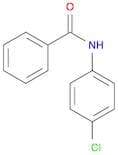
CAS 2866-82-2
:N-(4-Chlorophenyl)benzamide
Description:
N-(4-Chlorophenyl)benzamide, with the CAS number 2866-82-2, is an organic compound characterized by its amide functional group and aromatic structure. It features a benzamide core where a 4-chlorophenyl group is attached to the nitrogen atom of the amide. This compound typically appears as a solid at room temperature and is soluble in organic solvents such as ethanol and dimethyl sulfoxide, but has limited solubility in water due to its hydrophobic aromatic rings. The presence of the chlorine atom enhances its lipophilicity and may influence its biological activity. N-(4-Chlorophenyl)benzamide is of interest in various fields, including medicinal chemistry, where it may serve as a scaffold for drug development or as a potential intermediate in organic synthesis. Its chemical properties, such as melting point, boiling point, and reactivity, can vary based on the specific conditions and purity of the sample. Safety precautions should be observed when handling this compound, as with many organic chemicals, due to potential toxicity and environmental impact.
Formula:C13H10ClNO
InChI:InChI=1S/C13H10ClNO/c14-11-6-8-12(9-7-11)15-13(16)10-4-2-1-3-5-10/h1-9H,(H,15,16)
InChI key:InChIKey=PJFPJLMLHHTWDZ-UHFFFAOYSA-N
SMILES:C(NC1=CC=C(Cl)C=C1)(=O)C2=CC=CC=C2
Synonyms:- Benzamide, N-(4-chlorophenyl)-
- Benzanilide, 4′-chloro-
- N-(4-Chlorophenyl)-benzamide
- N-(p-Chlorophenyl)benzamide
- N-Benzoyl-4-chloroaniline
- NSC 83620
- 4′-Chlorobenzanilide
Sort by
Purity (%)
0
100
|
0
|
50
|
90
|
95
|
100
Found 4 products.
N-(4-Chlorophenyl)benzamide
CAS:Formula:C13H10ClNOPurity:95%Color and Shape:SolidMolecular weight:231.6776N-(4-Chlorophenyl)benzenecarboxamide
CAS:N-(4-Chlorophenyl)benzenecarboxamide (PCBAA) is a reactive amide. It is used to prepare the corresponding acid chloride, which can be reacted with alcohols or amines to form esters and amides respectively. The rate of the reaction between PCBAA and water is linearly dependent on the concentration of PCBAA. The reaction is first order in both reactants and second order overall. The theory behind this chemical reaction is called nucleophilic attack theory, in which a nucleophile attacks an electrophilic carbon atom in an organic molecule. This mechanism occurs when a nucleophile such as water or alcohol attacks the carbonyl group of PCBAA, leading to a nucleophilic addition.Formula:C13H10ClNOPurity:Min. 95%Molecular weight:231.68 g/mol