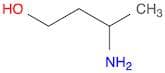
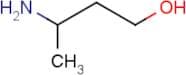
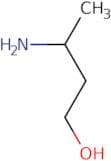
CAS 2867-59-6
:3-Amino-1-butanol
Description:
3-Amino-1-butanol, with the CAS number 2867-59-6, is an organic compound characterized by the presence of both an amino group (-NH2) and a hydroxyl group (-OH) attached to a four-carbon butane chain. This compound is a colorless to pale yellow liquid that is hygroscopic, meaning it can absorb moisture from the air. It has a relatively low molecular weight and exhibits basic properties due to the amino group, allowing it to participate in various chemical reactions, including nucleophilic substitutions and condensation reactions. 3-Amino-1-butanol is soluble in water and many organic solvents, making it versatile in chemical applications. It is often used as an intermediate in the synthesis of pharmaceuticals, agrochemicals, and other fine chemicals. Additionally, its structure allows it to act as a chiral building block in asymmetric synthesis. Safety considerations include handling it with care, as it may cause irritation to the skin and eyes. Overall, 3-Amino-1-butanol is a valuable compound in organic synthesis and industrial applications.
Formula:C4H11NO
InChI:InChI=1S/C4H11NO/c1-4(5)2-3-6/h4,6H,2-3,5H2,1H3
InChI key:InChIKey=AGMZSYQMSHMXLT-UHFFFAOYSA-N
SMILES:C(C(C)N)CO
Synonyms:- 1-Butanol, 3-Amino-
- 2-Amino-4-hydroxybutane
- 3-Amino-1-butanol
- 3-Amino-3-methylpropan-1-ol
- 3-Amino-butan-1-ol
- 3-Aminobutanol
Sort by
Purity (%)
0
100
|
0
|
50
|
90
|
95
|
100
Found 5 products.
3-Aminobutan-1-ol
CAS:3-Aminobutan-1-olFormula:C4H11NOPurity:97%Color and Shape: liquidMolecular weight:89.14g/mol3-Aminobutan-1-ol
CAS:3-Aminobutan-1-ol is an amine that is synthesized industrially by the reduction of soybean trypsin with borohydride. This chemical has been used as a substrate in asymmetric synthesis and can be detected by high detection sensitivity. 3-Aminobutan-1-ol binds to the carbonyl group of amino acid residues and causes a reaction with chloride ions for detection. The product of this reaction is an enantiomer, which can be separated from other reaction products by purified chiral stationary phases. 3-Aminobutan-1-ol is also involved in the biosynthesis of proteins and enzymes. It reacts with hydrochloric acid to form a salt, which can then be used as an enzyme inhibitor.
Formula:C4H11NOPurity:Min. 95%Color and Shape:Clear LiquidMolecular weight:89.14 g/mol