CAS 2876-63-3
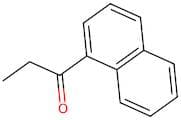
:1-(1-Naphthalenyl)-1-propanone
Description:
1-(1-Naphthalenyl)-1-propanone, also known as 1-naphthylpropan-1-one, is an organic compound characterized by its structure, which features a naphthalene ring attached to a propanone group. This compound typically appears as a colorless to pale yellow liquid or solid, depending on its purity and temperature. It has a relatively low solubility in water but is soluble in organic solvents such as ethanol and ether. The compound is known for its aromatic properties due to the presence of the naphthalene moiety, which contributes to its stability and reactivity. It is often used in organic synthesis and as an intermediate in the production of various chemical compounds. Additionally, 1-(1-Naphthalenyl)-1-propanone may exhibit biological activity, making it of interest in pharmaceutical research. Safety precautions should be taken when handling this substance, as it may pose health risks if ingested or inhaled. Proper storage in a cool, dry place away from light is recommended to maintain its integrity.
Formula:C13H12O
InChI:InChI=1S/C13H12O/c1-2-13(14)12-9-5-7-10-6-3-4-8-11(10)12/h3-9H,2H2,1H3
InChI key:InChIKey=QFLRYLKUSFJFTK-UHFFFAOYSA-N
SMILES:C(CC)(=O)C=1C2=C(C=CC1)C=CC=C2
Synonyms:- 1-(1-Naphthalenyl)-1-propanone
- 1-(1-Naphthyl)-1-propanone
- 1-(1-Naphthyl)propan-1-one
- 1-(Naphthalen-1-yl)propanone
- 1-Propanone, 1-(1-Naphthalenyl)-
- 1-Propionylnaphthalene
- 1′-Propionaphthone
- Ethyl 1-naphthyl ketone
- NSC 406948
Sort by
Purity (%)
0
100
|
0
|
50
|
90
|
95
|
100
Found 3 products.
1-naphthalen-1-ylpropan-1-one
CAS:Controlled Product1-Naphthalen-1-ylpropan-1-one is a synthetic compound that was originally developed as a suppressant for the treatment of tuberculosis. It has been shown to be effective in inhibiting the growth of cryptococcus neoformans, but not of C. neoformans. It is also used as a precursor for the synthesis of chiral derivatives, such as cetirizine and albuterol. 1-Naphthalen-1-ylpropan-1-one has been shown to inhibit the growth of bacteria by preventing the conversion of propionyl CoA to succinyl CoA, which inhibits production of ATP and reduces cellular energy stores. This may be due to its ability to react with chloride ions and form a stable product that can't be metabolized by bacteria.Formula:C13H12OPurity:Min. 95%Molecular weight:184.23 g/mol