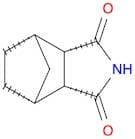
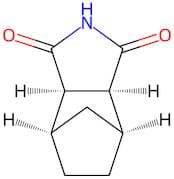
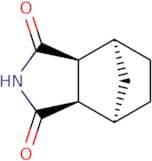
CAS 28871-95-6
:endo-2,3-Norbornanedicarboximide
Description:
Endo-2,3-Norbornanedicarboximide, identified by its CAS number 28871-95-6, is a bicyclic compound characterized by its unique norbornane structure, which features a fused cyclobutane and cyclopentane ring system. This compound contains two carboximide functional groups, which contribute to its chemical reactivity and potential applications in various fields, including materials science and organic synthesis. The endo configuration indicates that the substituents are oriented towards the interior of the bicyclic system, influencing its steric and electronic properties. Typically, compounds like endo-2,3-Norbornanedicarboximide exhibit good thermal stability and can participate in various chemical reactions, such as cycloadditions and polymerizations. Its solubility is generally moderate in organic solvents, making it suitable for use in diverse chemical environments. Additionally, the presence of the carboximide groups can enhance its interactions with other molecules, potentially leading to applications in drug delivery or as intermediates in the synthesis of more complex organic compounds. Overall, endo-2,3-Norbornanedicarboximide is a versatile compound with significant implications in both academic research and industrial applications.
Sort by
Purity (%)
0
100
|
0
|
50
|
90
|
95
|
100
Found 5 products.
(3Ar,4r,7s,7as)-hexahydro-1h-4,7-methanoisoindole-1,3(2h)-dione
CAS:Formula:C9H11NO2Purity:98%Color and Shape:SolidMolecular weight:165.1891endo-2,3-Norbornanedicarboximide
CAS:endo-2,3-NorbornanedicarboximidePurity:98%Molecular weight:165.19g/mol(3aR,4R,7S,7aS)-Hexahydro-1H-4,7-methanoisoindole-1,3(2H)-dione
CAS:Purity:98%Molecular weight:165.19Endo-2,3-norbornanedicarboximide
CAS:Endo-2,3-norbornanedicarboximide (ENBDC) is a dopamine receptor antagonist that has been shown to have atypical antipsychotic activity. ENBDC binds to the serotonin 5-HT2A receptor, which inhibits neurotransmission and induces dopamine release. It also inhibits the dopamine D2 receptor, which may lead to its therapeutic effect. The hydroxyl group on the molecule interacts with the drug's binding site, enhancing its affinity for this region of the receptor. Fluoro groups are found on both ends of ENBDC and are responsible for its high lipophilicity, allowing it to cross the blood brain barrier and act as an antagonist in the central nervous system.Formula:C9H11NO2Purity:Min. 95%Molecular weight:165.19 g/mol