CAS 29086-41-7
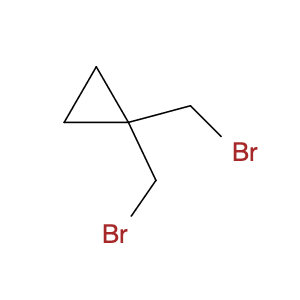
:1,1-Bis(bromomethyl)cyclopropane
Description:
1,1-Bis(bromomethyl)cyclopropane is an organic compound characterized by its unique cyclopropane structure, which consists of a three-membered carbon ring. The presence of two bromomethyl groups attached to the same carbon atom of the cyclopropane ring significantly influences its reactivity and properties. This compound is typically a colorless to pale yellow liquid and is known for its high reactivity due to the presence of bromine atoms, which can participate in various substitution and addition reactions. It is often used as an intermediate in organic synthesis, particularly in the preparation of more complex molecules. The compound is sensitive to light and moisture, necessitating careful handling and storage conditions. Additionally, it may pose health hazards, including toxicity and potential carcinogenicity, thus requiring appropriate safety measures during use. Its applications can extend to fields such as pharmaceuticals and agrochemicals, where it serves as a building block for more intricate chemical structures.
Formula:C5H8Br2
InChI:InChI=1S/C5H8Br2/c6-3-5(4-7)1-2-5/h1-4H2
InChI key:InChIKey=GJCHFNVRRQTXHL-UHFFFAOYSA-N
SMILES:C(Br)C1(CBr)CC1
Synonyms:- 1,1-Bis(bromomethyl)cyclopropane
- 1,1-Di(bromomethyl)cyclopropane
- Cyclopropane, 1,1-bis(bromomethyl)-
Sort by
Purity (%)
0
100
|
0
|
50
|
90
|
95
|
100
Found 4 products.
1,1-bis(bromomethyl)cyclopropane
CAS:Formula:C5H8Br2Purity:96%Color and Shape:LiquidMolecular weight:227.92501,1-bis-(Bromomethyl)cyclopropane
CAS:1,1-bis-(Bromomethyl)cyclopropanePurity:95%Molecular weight:227.93g/mol1,1-Bis(bromomethyl)cyclopropane
CAS:Formula:C5H8Br2Purity:96%Color and Shape:OilMolecular weight:227.9271,1-Bis(bromomethyl)cyclopropane
CAS:1,1-Bis(bromomethyl)cyclopropane (1,1-BMC) is a brominated derivative of the cyclopropane molecule that has been used as a tracer to investigate atmospheric reactions. 1,1-BMC can be used as an anion indicator in electrochemical experiments because it is sensitive to the charge on the electrode surface. Kinetic studies have shown that 1,1-BMC reacts with ozone at low concentrations and with hydrogen peroxide at high concentrations. This reactivity is consistent with the sensitivity of 1,1-BMC to anions. The sensitivity of 1,1-BMC may be due to its ability to form enamines or imines when exposed to ozone or hydrogen peroxide. As a result of these reactions, 1,1-BMC becomes oxidized and forms positive charges that are detected by voltmeters. This electrochemical analysis technique has been applied to air samples from the troposphereFormula:C5H8Br2Purity:Min. 95%Molecular weight:227.94 g/mol