CAS 294-92-8
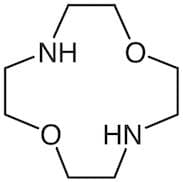
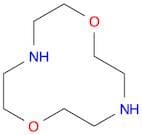
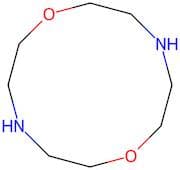
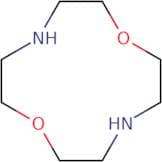
:1,7-Dioxa-4,10-diazacyclododecane
Description:
1,7-Dioxa-4,10-diazacyclododecane, also known by its CAS number 294-92-8, is a cyclic compound featuring a unique structure that includes both nitrogen and oxygen atoms within its ring. This compound is characterized by a twelve-membered ring containing two nitrogen atoms and two oxygen atoms, which contribute to its chelating properties. It is often studied for its potential applications in coordination chemistry, particularly in the formation of complexes with metal ions. The presence of the nitrogen atoms allows for the formation of stable complexes, making it of interest in fields such as catalysis and materials science. Additionally, the compound may exhibit interesting solubility and reactivity profiles due to its heteroatom content. Its structural features can influence its biological activity, making it a candidate for further research in medicinal chemistry. Overall, 1,7-Dioxa-4,10-diazacyclododecane represents a versatile scaffold for the development of new chemical entities.
Formula:C8H18N2O2
InChI:InChI=1S/C8H18N2O2/c1-5-11-7-3-10-4-8-12-6-2-9-1/h9-10H,1-8H2
InChI key:InChIKey=PWJHXHMUGFXPSN-UHFFFAOYSA-N
SMILES:C1COCCNCCOCCN1
Synonyms:- 1,7-Diaza-12-crown-4
- 1,7-Diaza-4,10-dioxacyclododecane
- 1,7-Dioxa-4,10-Diazacyclododecane
- 1,7-Dioxa-4,10-Diazoniacyclododecane
- 4,10-Diaza-12-crown-4
Sort by
Purity (%)
0
100
|
0
|
50
|
90
|
95
|
100
Found 5 products.
4,10-Diaza-12-crown 4-Ether
CAS:Formula:C8H18N2O2Purity:>96.0%(GC)(T)Color and Shape:White to Light yellow powder to crystalMolecular weight:174.241,7-Dioxa-4,10-diazacyclododecane
CAS:Formula:C8H18N2O2Purity:96%Color and Shape:SolidMolecular weight:174.24074,10-Diaza-12-crown 4-Ether
CAS:4,10-Diaza-12-crown 4-Ether is a nitrogenous heterocyclic compound and contains three nitrogen atoms. The molecule has a coordination geometry of square pyramidal. The protonation state of the molecule can be determined by titration calorimetry. The analytical chemistry technique used to determine the protonation state was titration calorimetry. This molecule has two stable complexes with sodium salts in methanol at room temperature. The chemical structure of this molecule is shown below:Formula:C8H18N2O2Purity:Min. 95%Molecular weight:174.24 g/mol