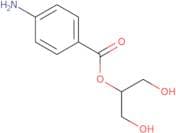
CAS 29593-08-6
:1,2,3-Propanetriol, mono(4-aminobenzoate)
Description:
1,2,3-Propanetriol, mono(4-aminobenzoate), also known as glycerol monobenzoate, is an ester formed from glycerol and 4-aminobenzoic acid. This compound typically appears as a colorless to pale yellow liquid or solid, depending on its specific formulation and purity. It is characterized by its hydrophilic nature due to the presence of hydroxyl groups from glycerol, which allows it to interact well with water and other polar solvents. The 4-aminobenzoate moiety introduces an aromatic component, contributing to its potential applications in pharmaceuticals and cosmetics, particularly as a stabilizer or emulsifier. The compound may exhibit biological activity, including antimicrobial properties, making it of interest in various fields, including biochemistry and materials science. Its solubility, reactivity, and compatibility with other substances are influenced by its molecular structure, which includes both hydrophilic and hydrophobic characteristics. Safety data should be consulted for handling and usage, as with any chemical substance.
Formula:C10H13NO4
InChI:InChI=1/C10H13NO4/c11-8-3-1-7(2-4-8)10(14)15-9(5-12)6-13/h1-4,9,12-13H,5-6,11H2
SMILES:c1cc(ccc1C(=O)OC(CO)CO)N
Synonyms:- 1,2,3-Propanetriol, mono(4-aminobenzoate)
- 1,3-Dihydroxypropan-2-Yl 4-Aminobenzoate
- Benzoic acid, p-amino-, monoester with glycerol
- Caswell No. 581
- EPA Pesticide Chemical Code 009102
- Glycerol mono-p-aminobenzoate
- Monoglyceryl p-aminobenzoate
- Glycerol 4-aminobenzoate
Sort by
Purity (%)
0
100
|
0
|
50
|
90
|
95
|
100
Found 2 products.
Glyceryl-4-aminobenzoate monomer
CAS:Glyceryl-4-aminobenzoate monomer is a fine chemical that is an important building block in the synthesis of a variety of complex compounds. It has been used as a reagent and intermediate in research and development of pharmaceuticals and agrochemicals. Glyceryl-4-aminobenzoate monomer is a versatile building block, which can be used to form polymers, coatings, adhesives, elastomers, polyurethanes, and more. The compound also has been shown to have anticancer activity against human breast cancer cells.
Formula:C10H13NO4Purity:Min. 75 Area-%Color and Shape:Off-white to beige solid.Molecular weight:211.21 g/mol