CAS 29713-15-3
:1,3-Adamantanedicarbonyl dichloride
Description:
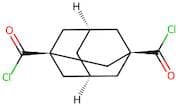
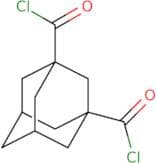
1,3-Adamantanedicarbonyl dichloride, with the CAS number 29713-15-3, is a chemical compound characterized by its unique adamantane structure, which consists of a diamond-like cage of carbon atoms. This compound features two carbonyl (C=O) groups, each bonded to a chlorine atom, making it a dichloride derivative. It is typically a solid at room temperature and exhibits a crystalline appearance. The presence of the carbonyl groups contributes to its reactivity, particularly in nucleophilic substitution reactions, making it useful in organic synthesis. The dichloride functionality allows for the introduction of various nucleophiles, facilitating the formation of diverse derivatives. Additionally, 1,3-Adamantanedicarbonyl dichloride is relatively stable under standard conditions but should be handled with care due to its potential reactivity and the toxicity associated with chlorine-containing compounds. Its applications may extend to the synthesis of pharmaceuticals, agrochemicals, and other organic materials, highlighting its significance in chemical research and industry.
Formula:C12H14Cl2O2
InChI:InChI=1/C12H14Cl2O2/c13-9(15)11-2-7-1-8(4-11)5-12(3-7,6-11)10(14)16/h7-8H,1-6H2
SMILES:C1C2CC3(CC1CC(C2)(C3)C(=O)Cl)C(=O)Cl
Synonyms:- Tricyclo[3.3.1.13,7]decane-1,3-dicarbonyl dichloride
- 1,3-Adamantanedicarbonyl chloride
- Tricyclo[3.3.1.1~3,7~]Decane-1,3-Dicarbonyl Dichloride
Sort by
Purity (%)
0
100
|
0
|
50
|
90
|
95
|
100
Found 3 products.
Tricyclo[3.3.1.13,7]decane-1,3-dicarbonyl dichloride
CAS:Formula:C12H14Cl2O2Molecular weight:261.14441,3-Adamantanedicarbonyl chloride
CAS:1,3-Adamantanedicarbonyl chloridePurity:95%Molecular weight:261.15g/mol1,3-Adamantanedicarbonylchloride
CAS:1,3-Adamantanedicarbonylchloride is a monomer that can be used in anticancer drug development. It is an analog of 1,3-diaminopropane, which has been shown to inhibit the growth of cancer cells and induce their apoptosis. The structure of 1,3-Adamantanedicarbonylchloride has been characterized by NMR spectroscopy under various conditions. The compound reacts with amines to form chlorides and alicyclic compounds. Friedel-Crafts acylation with chloride gives the corresponding carboxylate derivative. This reaction is reversible and can be carried out at room temperature or above.
Formula:C12H14Cl2O2Purity:Min. 95%Color and Shape:PowderMolecular weight:261.14 g/mol
![Tricyclo[3.3.1.13,7]decane-1,3-dicarbonyl dichloride](/_next/image/?url=https%3A%2Fstatic.cymitquimica.com%2Fproducts%2FIN%2Fthumb%2FDA002Z6U.jpg&w=3840&q=75)