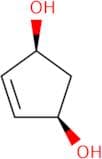
CAS 29783-26-4
:cis-4-cyclopentene-1,3-diol
Description:
Cis-4-cyclopentene-1,3-diol is an organic compound characterized by its unique cyclic structure and the presence of hydroxyl (-OH) functional groups. As a derivative of cyclopentene, it features a five-membered carbon ring with a double bond and two alcohol groups located at the 1 and 3 positions of the ring, with the cis configuration indicating that the hydroxyl groups are on the same side of the double bond. This compound is typically a colorless to pale yellow liquid and is soluble in water due to the polar nature of the hydroxyl groups. Its chemical properties include potential reactivity in various organic reactions, such as oxidation and substitution, making it of interest in synthetic organic chemistry. Additionally, the presence of the double bond contributes to its reactivity, allowing for further functionalization. The compound's specific applications may vary, but it can serve as an intermediate in the synthesis of more complex organic molecules or in the development of pharmaceuticals and agrochemicals.
Formula:C5H8O2
InChI:InChI=1/C5H8O2/c6-4-1-2-5(7)3-4/h1-2,4-7H,3H2/t4-,5+
Synonyms:- (1R,3S)-cyclopent-4-ene-1,3-diol
Sort by
Purity (%)
0
100
|
0
|
50
|
90
|
95
|
100
Found 4 products.
cis-4-Cyclopentene-1,3-diol
CAS:Formula:C5H8O2Purity:96%Color and Shape:SolidMolecular weight:100.1158cis-4-Cyclopentene-1,3-diol
CAS:cis-4-Cyclopentene-1,3-diol is a useful chemical intermediate that can be converted to diacetate, acetylation, or chloroacetate. It has a reactive functional group that can be used for synthesizing polymers and other compounds. cis-4-Cyclopentene-1,3-diol is also an excellent substrate for lipase reactions and it reacts with hydrogen fluoride to give desired products. This section has conformational properties that make it suitable for hydrogen bonding and can act as a ligand in coordination chemistry. cis-4-Cyclopentene-1,3-diol is also able to undergo substitution at the carbonyl carbon atom by various reagents such as fluorine.Formula:C5H8O2Purity:Min. 95%Color and Shape:PowderMolecular weight:100.12 g/mol