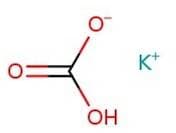
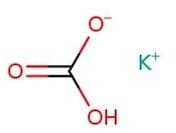
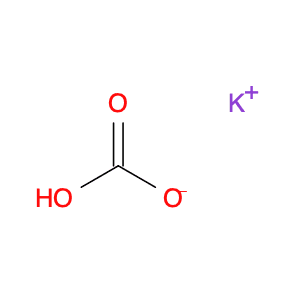
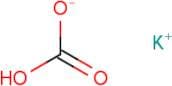
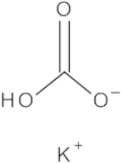
CAS 298-14-6
:Carbonic acid, monopotassium salt
- Armicarb
- Carbonic acid, potassium salt (1:1)
- EcoCarb
- EcoMate Armicarb "O"
- Hidrogenocarbonato De Potasio
- Hydrogen potassium carbonate
- Hydrogenocarbonate de potassium
- K-Lyte
- Kafylox
- Kaligreen
- Kaliumhydrogencarbonat
- Milstop
- Monopotassium carbonate
- Potassium Bicarbonate
- Potassium Hydrogencarbonate
- Potassium acid carbonate
- Potassium bicarbonate (KHCO3)
- Potassium bicarbonate (KHCO<sub>3</sub>)
- Potassium carbonate (KHCO3)
- Potassium carbonate (KHCO<sub>3</sub>)
- Potassium hydrocarbonate
- Potassium hydrogen carbonate
- Potassium hydrogen carbonate (KHCO3)
- Potassium hydrogen carbonate (KHCO<sub>3</sub>)
- Purple K
- Carbonic acid, monopotassium salt
- POTASSIUM BICARBONATE USP
- POTASSIUM HYDROGENCARBONATE, REAGENT GRADE, >=98%
- POTASSIUM HYDROGEN CARBONATE, GRANULAR, 99.7%, A.C.S. REAGENT
- POTASSIUM HYDROGENCARBONATE GRANULAR &
- bicarbonate
- PotassiumHydrogenCarbonateUsp
- Potassion bicarbonate, Ph. Eur
- PotassiumHydrogenCarbonateA.R.
- SODIUM BICARBONATE SOLUTION, SATURATED, TECHN., S42, 50 L
- POTASSIUM BICARBONATE INSECT CELL*CULTUR E TESTED
- POTASSIUM HYDROGENCARBONATE, REAGENTPLUS , 99.99+%
- Carbonicacidmonopotassiumsalt
- Carbonicacid,monopotassiumsalt
- POTASSIUM HYDROGENCARBONATE REAGENT GR&
- POTASSIUM HYDROGEN CARBONATE EXTRA PURE, DAB, B. P. C., U. S. P.
- SODIUM BICARBONATE SOLUTION, SATURATED, TECHN., S42, 1 L
- See more synonyms
Potassium hydrogen carbonate, ACS, 99.7-100.5% (dried basis)
CAS:Maximum level of impurities: Insoluble matter 0.01%, Cl 0.001%, PO4 5ppm, SO4 0.003%, NH4 5ppm, Ca 0.002%, Mg 0.001%, Heavy Metals (as Pb) 5ppm, Fe 5ppm, Na 0.03%Formula:CHKO3Purity:99.7-100.5%Molecular weight:100.11Potassium hydrogen carbonate, 99%
CAS:Potassium hydrogen carbonate is used in foods to regulate pH, as a fire suppression agent (BC dry chemical) and as a buffering agent in medications. It acts as an additive in winemaking and is an active component in club soda. Furthermore, it finds use in crops for the neutralization of acidic soilsFormula:CHKO3Purity:99%Color and Shape:Crystals or powder or crystalline powder, WhiteMolecular weight:100.11Potassium Bicarbonate
CAS:Potassium carbonatesFormula:KHCO3Color and Shape:White PowderMolecular weight:99.95628Potassium hydrogen carbonate
CAS:Formula:KHCO3Purity:99.0 - 101.0 % (as KHCO3)Color and Shape:White crystalline powder or colourless crystalsMolecular weight:100.12Potassium Bicarbonate
CAS:Potassium Bicarbonate
Purity:95Color and Shape:SolidMolecular weight:100.12g/molPotassium Bicarbonate
CAS:Controlled ProductApplications Potassium bicarbonate is a catalyst in synthetic fiber polymerization and olefin dehydrogenation.
Formula:CHO3·KColor and Shape:White To Off-WhiteMolecular weight:100.12Potassium Bicarbonate extrapure, 99%
CAS:Formula:KHCO3Purity:min. 99.0%Color and Shape:White, Crystalline powder, Clear, ColourlessMolecular weight:100.12Potassium Bicarbonate ACS, ExiPlus, Multi-Compendial, 99.7%
CAS:Formula:KHCO3Purity:min. 99.7%Color and Shape:White, Crystalline powder, Clear, ColourlessMolecular weight:100.12Potassium bicarbonate
CAS:Formula:CHKO3Purity:99.0%Color and Shape:Solid, Crystalline Powder or PowderMolecular weight:100.114Potassium bicarbonate
CAS:Potassium bicarbonate is a chemical compound that is used as a buffer in a variety of applications. It is commonly used to maintain the pH of laboratory solutions and can be found in many home products such as baking powder, fire extinguishers, and antacids. Potassium bicarbonate has been shown to bind to metal ions, such as hydrogen fluoride and metal chelates, which may be responsible for its ability to inhibit cox-2 activity. Potassium bicarbonate also has high water permeability properties. This property makes it useful in blood sampling, where it causes the red blood cells to swell up and burst so they can be removed by centrifugation. Potassium bicarbonate also has hydrogen bonding interactions with water molecules (H2O).
Formula:KHCO3Purity:Min. 99.0%Color and Shape:White Clear LiquidMolecular weight:100.12 g/mol