CAS 29934-17-6
:trans-Dichlorobis(tricyclohexylphosphine)palladium(II)
Description:
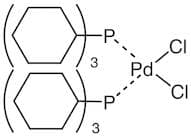
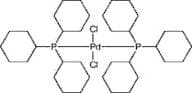
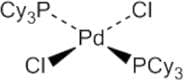
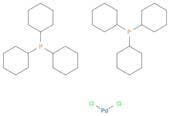
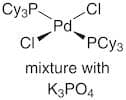
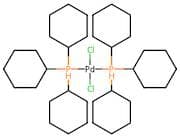
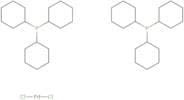
Trans-Dichlorobis(tricyclohexylphosphine)palladium(II) is a coordination complex of palladium with the formula PdCl2(P(C6H11)3)2. This compound features a palladium center coordinated to two chloride ions and two tricyclohexylphosphine ligands, resulting in a square planar geometry typical of palladium(II) complexes. The tricyclohexylphosphine ligands contribute to the steric bulk and electronic properties of the complex, enhancing its stability and reactivity in various chemical reactions, particularly in catalysis. The trans configuration indicates that the chloride ligands are positioned opposite each other, which influences the compound's reactivity and interaction with substrates. This complex is often utilized in organic synthesis, especially in cross-coupling reactions, due to its ability to facilitate the formation of carbon-carbon bonds. Additionally, it exhibits solubility in organic solvents, making it suitable for use in various synthetic environments. Safety precautions should be observed when handling this compound, as palladium complexes can be toxic and should be managed in accordance with appropriate laboratory safety protocols.
Formula:C36H66Cl2P2Pd
InChI:InChI=1/2C18H33P.2ClH.Pd/c2*1-4-10-16(11-5-1)19(17-12-6-2-7-13-17)18-14-8-3-9-15-18;;;/h2*16-18H,1-15H2;2*1H;/q;;;;+2/p-2
SMILES:C1CCC(CC1)P(C1CCCCC1)C1CCCCC1.C1CCC(CC1)P(C1CCCCC1)C1CCCCC1.Cl.Cl.[Pd]
Synonyms:- Dichlorobis(tricyclohexylphosphine)palladium(II)
- Dichloropalladium-Tricyclohexylphosphane (1:2)
- Bis(tricyclohexylphosphine)palladium(II) Dichlorid
Sort by
Purity (%)
0
100
|
0
|
50
|
90
|
95
|
100
Found 9 products.
Bis(tricyclohexylphosphine)palladium(II) Dichloride
CAS:Formula:C36H66Cl2P2PdPurity:>97.0%(T)Color and Shape:Light orange to Yellow to Green powder to crystalMolecular weight:738.19Dichlorobis(tricyclohexylphosphine)palladium(II)
CAS:It is used as catalyst for C-C and C-N coupling reaction. It is used in the homogeneous carbonylation of chloroarenes under mild conditions. This Thermo Scientific Chemicals brand product was originally part of the Alfa Aesar product portfolio. Some documentation and label information may refer to tFormula:C36H66Cl2P2PdMolecular weight:738.18trans-Dichlorobis(tricyclohexylphosphine)palladium(II), 99%
CAS:trans-Dichlorobis(tricyclohexylphosphine)palladium(II), 99%
Formula:PdCl2(C6H11)3PPurity:99%Color and Shape:light yellow pwdr.Molecular weight:738.19Dichlorobis(tricyclohexylphosphine)palladium(II)
CAS:Formula:C36H66Cl2P2PdPurity:98%Color and Shape:SolidMolecular weight:738.1828trans-Dichlorobis(tricyclohexylphosphine)palladium(II)/potassium phosphate admixture [CatKit single-use vials - 6.62 wt% Pd complex]
CAS:trans-Dichlorobis(tricyclohexylphosphine)palladium(II)/potassium phosphate admixture [CatKit single-use vials - 6.62 wt% Pd complex]
Formula:PdCl2(C6H11)3PK3PO4Color and Shape:off-white pwdr.Molecular weight:736.30516Dichlorobis(tricyclohexylphosphine)palladium(II)
CAS:Dichlorobis(tricyclohexylphosphine)palladium(II)Formula:C36H68Cl2P2PdPurity:98%Color and Shape: light yellow to yellow solidMolecular weight:740.20g/molDichloro(tricyclohexylphosphine)palladium (II)
CAS:Formula:C36H66Cl2P2PdPurity:95%Color and Shape:SolidMolecular weight:738.19Bis(Tricyclohexylphosphine)Palladium(II) Dichloride extrapure, 98%
CAS:Formula:C36H66Cl2P2PColor and Shape:Yellow, PowderMolecular weight:738.1Bis(tricyclohexylphosphine)palladium(II) Dichloride
CAS:Controlled ProductBis(tricyclohexylphosphine)palladium(II) Dichloride is a cross-coupling agent that is used for the synthesis of organic and organometallic compounds. It reacts with terminal alkynes to form a phosphine oxide, which can then be converted into an arylated product. The reaction proceeds by the formation of a palladium-carbon bond and subsequent cleavage of the carbon-palladium bond in the presence of ammonium formate. Bis(tricyclohexylphosphine)palladium(II) Dichloride is insoluble in water, but soluble in organic solvents such as dichloromethane, 1,2-dichloroethane, or chloroform. This reagent has been shown to enhance the rate of transfer reactions between monomers.Formula:C36H66Cl2P2PdPurity:Min. 95%Molecular weight:738.18 g/mol