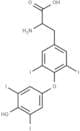
CAS 300-30-1
:(±)-Thyroxine
Description:
(±)-Thyroxine, also known as L-thyroxine or T4, is a hormone produced by the thyroid gland that plays a crucial role in regulating metabolism, growth, and development in the body. It is a tetraiodinated derivative of the amino acid tyrosine, characterized by the presence of four iodine atoms in its structure. This compound is typically found as a white to off-white crystalline powder and is soluble in water, making it bioavailable for physiological functions. The molecular formula of thyroxine is C15H11I4N0, and it has a relatively high molecular weight. Thyroxine acts primarily by binding to thyroid hormone receptors in various tissues, influencing gene expression and metabolic processes. It is essential for maintaining normal metabolic rates and is often used therapeutically to treat hypothyroidism, where the body does not produce enough thyroid hormones. Due to its significant role in metabolism, any imbalance in thyroxine levels can lead to various health issues, including weight changes, energy levels, and overall metabolic function.
Formula:C15H11I4NO4
InChI:InChI=1S/C15H11I4NO4/c16-8-4-7(5-9(17)13(8)21)24-14-10(18)1-6(2-11(14)19)3-12(20)15(22)23/h1-2,4-5,12,21H,3,20H2,(H,22,23)
InChI key:InChIKey=XUIIKFGFIJCVMT-UHFFFAOYSA-N
SMILES:O(C1=CC(I)=C(O)C(I)=C1)C2=C(I)C=C(CC(C(O)=O)N)C=C2I
Synonyms:- DL-Thyroxine
- O-(4-Hydroxy-3,5-diiodophenyl)-3,5-diiodotyrosine
- Tyrosine, O-(4-hydroxy-3,5-diiodophenyl)-3,5-diiodo-
- Thyroxine, DL-
- DL-Tyrosine, O-(4-hydroxy-3,5-diiodophenyl)-3,5-diiodo-
- DL-3-[4-(4-HYDROXY-3,5-DIIODOPHENOXY)-3,5-DIIODOPHENYL]ALANINE
- DL-3,3',5,5'-TETRAIODOTHYRONINE
- O-(4-hydroxy-3,5-diiodophenyl)-3,5-diiodo-DL-tyrosine
- DL-ThyroxinefreeAcid
- 3-[4-(4-HYDROXY-3,5-DIIODOPHENOXY)-3,5-DIIODOPHENYL]ALANINE
- 3,3',5,5'-TETRAIODO-DL-THYRONINE
- Thyroxine, DL-(8CI)
- Tyrosine, O-(4-hydroxy-3,5-diiodophenyl)-3,5-diiodo-(9CI)
- 3-[4-(4-HYDROXY-3,5-DIIODOPHENOXY)-3,5-DIIODOPHENYL]ALANINE 98%
- 2-AMINO-3-[4-(4-HYDROXY-3,5-DIIODOPHENOXY)-3,5-DIIODOPHENYL]PROPIONIC ACID
- DL-3,5-DIIODO-4-(3',5'-DIIODO-4'-HYDROPHENOXY)-PHENYLALANINE
- See more synonyms
Sort by
Purity (%)
0
100
|
0
|
50
|
90
|
95
|
100
Found 3 products.
2-Amino-3-[4-(4-hydroxy-3,5-diiodo-phenoxy)-3,5-diiodo-phenyl]propanoic acid
CAS:2-Amino-3-[4-(4-hydroxy-3,5-diiodo-phenoxy)-3,5-diiodo-phenyl]propanoic acidPurity:≥95%Molecular weight:776.87g/molDL-Thyroxine
CAS:DL-Thyroxine is a thyroid hormone that acts as a monoamine oxidase (monoamine oxidase) inhibitor.Formula:C15H11I4NO4Color and Shape:SolidMolecular weight:776.87


![2-Amino-3-[4-(4-hydroxy-3,5-diiodo-phenoxy)-3,5-diiodo-phenyl]propanoic acid](/_next/image/?url=https%3A%2Fstatic.cymitquimica.com%2Fproducts%2F54%2Fthumb%2FOR480373.jpg&w=3840&q=75)