CAS 30273-39-3
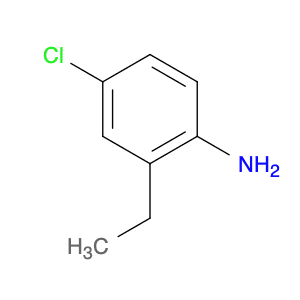
:4-Chloro-2-ethylbenzenamine
Description:
4-Chloro-2-ethylbenzenamine, also known as 4-chloro-2-ethyl-aniline, is an organic compound characterized by the presence of an aniline group substituted with a chloro and an ethyl group on the benzene ring. Its molecular formula is C9H10ClN, indicating it contains nine carbon atoms, ten hydrogen atoms, one chlorine atom, and one nitrogen atom. This compound typically appears as a colorless to pale yellow liquid or solid, depending on its state at room temperature. It is known for its aromatic properties and is soluble in organic solvents, while exhibiting limited solubility in water. The presence of the chloro group introduces reactivity that can be exploited in various chemical reactions, such as nucleophilic substitutions. 4-Chloro-2-ethylbenzenamine is utilized in the synthesis of dyes, pharmaceuticals, and agrochemicals, making it significant in industrial applications. However, like many amines, it may pose health risks, necessitating proper handling and safety measures during use.
Formula:C8H10ClN
InChI:InChI=1S/C8H10ClN/c1-2-6-5-7(9)3-4-8(6)10/h3-5H,2,10H2,1H3
InChI key:InChIKey=FRZVXNRFFMHYFO-UHFFFAOYSA-N
SMILES:C(C)C1=C(N)C=CC(Cl)=C1
Synonyms:- (4-Chloro-2-ethylphenyl)amine
- 2-Ethyl-4-chloroaniline
- 4-Chloro-2-ethylbenzenamine
- Aniline, 4-chloro-2-ethyl-
- Benzenamine, 4-Chloro-2-Ethyl-
- 4-Chloro-2-ethylaniline
Sort by
Purity (%)
0
100
|
0
|
50
|
90
|
95
|
100
Found 4 products.
Benzenamine, 4-chloro-2-ethyl-
CAS:Formula:C8H10ClNPurity:95%Color and Shape:LiquidMolecular weight:155.6247(4-Chloro-2-ethylphenyl)amine
CAS:Formula:C8H10ClNPurity:97%Color and Shape:Solid, FlakesMolecular weight:155.63(4-Chloro-2-ethylphenyl)amine
CAS:4-Chloro-2-ethylphenyl)amine is a carcinogen that has been shown to damage mammalian cells. The compound causes mutations in the DNA of cells, and is mutagenic and damaging. 4-Chloro-2-ethylphenyl)amine can be eliminated from the body through metabolic processes, but also can be metabolized by reagents to form other compounds that are mutagenic or carcinogenic. This chemical has been shown to cause mutations in the DNA of Salmonella typhimurium and Typhimurium strains, as well as causing damage to their DNA.
Formula:C8H10ClNPurity:Min. 95%Molecular weight:155.63 g/mol