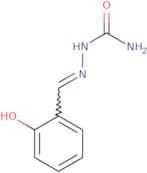
CAS 3030-97-5
:Salicylaldehyde, semicarbazone
Description:
Salicylaldehyde semicarbazone is an organic compound formed by the reaction of salicylaldehyde with semicarbazide. It is characterized by its molecular formula, which typically includes carbon, hydrogen, nitrogen, and oxygen atoms. This compound appears as a crystalline solid and is known for its distinctive properties, including a melting point that varies depending on purity and conditions. Salicylaldehyde semicarbazone exhibits notable reactivity due to the presence of both the aldehyde and semicarbazone functional groups, making it useful in various chemical applications, including as a reagent in analytical chemistry. It can participate in condensation reactions and is often employed in the synthesis of other organic compounds. Additionally, this compound may exhibit biological activity, which has been explored in various studies. Its solubility in organic solvents and limited solubility in water are also important characteristics that influence its applications in laboratory settings. Overall, salicylaldehyde semicarbazone serves as a valuable compound in both synthetic and analytical chemistry.
Formula:C8H9N3O2
InChI:InChI=1S/C8H9N3O2/c9-8(13)11-10-5-6-3-1-2-4-7(6)12/h1-5,12H,(H3,9,11,13)
InChI key:InChIKey=IZXDQSKCOWSUOG-UHFFFAOYSA-N
SMILES:C(=NNC(N)=O)C1=C(O)C=CC=C1
Synonyms:- 2-[(2-Hydroxyphenyl)methylene]hydrazinecarboxamide
- NSC 1604
- Hydrazinecarboxamide, 2-[(2-hydroxyphenyl)methylene]-
- 2-Hydroxybenzaldehyde semicarbazone
- Salicylaldehyde, semicarbazone
- [[(Z)-(6-oxocyclohexa-2,4-dien-1-ylidene)methyl]amino]urea
- 1-(2-Hydroxybenzylidene)semicarbazide
- AI3-03678
- 2-(2-Hydroxybenzylidene)hydrazinecarboxamide
- 2-(2-Hydroxybenzylidene)hydrazine-1-carboxamide
- {[(2-hydroxyphenyl)methylidene]amino}urea
- See more synonyms
Sort by
Purity (%)
0
100
|
0
|
50
|
90
|
95
|
100
Found 2 products.
2-(2-Hydroxybenzylidene)hydrazinecarboxamide
CAS:2-(2-Hydroxybenzylidene)hydrazinecarboxamide is a molecule that has been shown to inhibit the growth of leukemia cells. It interacts with the hydroxyl group of the 2-position of hydrazinecarboxamide, forming an intermediate which reacts with oxygen in the presence of a catalytic amount of ferrous ions to form a peroxide. The peroxide reacts with nitrogen atoms on the leukemia cells to form reactive species that cause cell death. 2-(2-Hydroxybenzylidene)hydrazinecarboxamide has also been shown to have anti-cancer activity against HLA-A2+ human leukemia HL-60 cells at concentrations as low as 0.1 μM.Formula:C8H9N3O2Purity:Min. 95%Molecular weight:179.18 g/mol
![{[(2-hydroxyphenyl)methylidene]amino}urea](/_next/image/?url=https%3A%2Fstatic.cymitquimica.com%2Fproducts%2FIN%2Fthumb%2FDA002ZL9.jpg&w=3840&q=75)