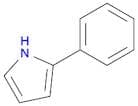
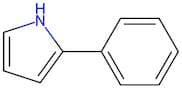
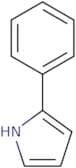
CAS 3042-22-6
:2-Phenylpyrrole
Description:
2-Phenylpyrrole is an organic compound characterized by its bicyclic structure, which consists of a pyrrole ring fused to a phenyl group. This compound features a five-membered nitrogen-containing heterocycle (pyrrole) that contributes to its aromatic properties. The presence of the phenyl group enhances its stability and influences its reactivity, making it an interesting candidate in various chemical applications. 2-Phenylpyrrole is typically a colorless to pale yellow liquid or solid, depending on its purity and form. It is known for its potential use in organic synthesis, particularly in the development of dyes, pharmaceuticals, and agrochemicals. The compound exhibits moderate solubility in organic solvents, and its reactivity can be attributed to the electron-rich nature of the pyrrole nitrogen, which can participate in electrophilic substitution reactions. Additionally, 2-Phenylpyrrole can exhibit interesting photophysical properties, making it valuable in materials science and organic electronics. Safety data should be consulted for handling and storage, as with all chemical substances.
Formula:C10H9N
InChI:InChI=1S/C10H9N/c1-2-5-9(6-3-1)10-7-4-8-11-10/h1-8,11H
InChI key:InChIKey=IRTLROCMFSDSNF-UHFFFAOYSA-N
SMILES:C1(=CC=CN1)C2=CC=CC=C2
Synonyms:- 1H-pyrrole, 2-phenyl-
- 2-Phenylpyrrole
- NSC 94963
- Pyrrole, 2-phenyl-
- 2-Phenyl-1H-pyrrole
- 2-Phenyl-1H-pyrrole
Sort by
Purity (%)
0
100
|
0
|
50
|
90
|
95
|
100
Found 4 products.
2-Phenyl-1H-pyrrole
CAS:2-Phenyl-1H-pyrrole is a fungicide that has been shown to have high resistance against resistance mutants. The redox potential of 2-phenyl-1H-pyrrole is -0.8 volts, which is higher than the redox potential of most fungicides. This compound can be used as an alternative to other current fungicides due to its ability to inhibit the growth of fungi and bacteria, such as Penicillium sp., Cephalosporium sp., and Bacillus subtilis. 2-Phenyl-1H-pyrrole has also been shown to inhibit the growth of wild type strains, heterocycles, and alkylsulfonyl groups. It reacts with phenylpyrrole when dissolved in a reaction solution.
Formula:C10H9NPurity:Min. 95%Molecular weight:143.19 g/mol