CAS 30551-89-4
:Poly(allylamine)
Description:
Poly(allylamine) is a synthetic polymer characterized by its cationic nature, resulting from the presence of amine functional groups along its backbone. This polymer is derived from the polymerization of allylamine monomers, leading to a structure that can exhibit varying degrees of polymerization. Poly(allylamine) is soluble in water, particularly in acidic conditions, due to the protonation of its amine groups, which enhances its solubility and reactivity. It is known for its biocompatibility and is often utilized in biomedical applications, such as drug delivery systems and tissue engineering. Additionally, poly(allylamine) can form films and coatings, making it useful in surface modification and as a stabilizing agent in colloidal systems. Its ability to interact with negatively charged species allows it to be employed in various applications, including wastewater treatment and as a flocculant. Overall, poly(allylamine) is a versatile polymer with significant potential in both industrial and biomedical fields.
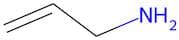
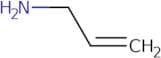
Formula:(C3H7N)x
InChI:InChI=1S/C3H7N/c1-2-3-4/h2H,1,3-4H2
InChI key:InChIKey=VVJKKWFAADXIJK-UHFFFAOYSA-N
SMILES:C(CN)=C
Synonyms:- 2-Propenamine homopolymer
- Allylamine homopolymer
- Allylamine polymer
- Allylamine, polymers
- N 15C
- PAA 25 (allyl polymer)
- PAA-L (polyamine)
- Pa 01
- Paa 005
- Paa 01
- Paa 03
- Paa 03E
- Paa 05
- Paa 08
- Paa 10C
- Paa 10L
- Paa 15
- Paa 15C
- Paa 1Lv
- Paa 1Lv40C
- Paa 25
- Paa 25C
- Paa-H
- Paa-H 10
- Paa-L
- Pas-F 5000
- Poly(2-propen-1-amine)
- Poly(allylamine)
- 2-Propen-1-amine, homopolymer
- Polyallylamine
- See more synonyms
Sort by
Purity (%)
0
100
|
0
|
50
|
90
|
95
|
100
Found 4 products.
2-Propen-1-amine, homopolymer
CAS:Formula:C3H7NPurity:%Color and Shape:SolidMolecular weight:57.0944Poly(allylamine) solution - Average MW 15000 15 % aqueous solution
CAS:Poly(allylamine) is a polymer that has antimicrobial properties and can be used to treat wastewater. It is synthesized from allyl bromide, sodium hydroxide, and water. Poly(allylamine) can also inhibit the activity of enzymes such as ATPase and lipase. The polymerization process leads to an increase in the number of hydroxyl groups, which are responsible for the antimicrobial properties. Poly(allylamine) solution has been shown to inhibit cell lysis and tumor growth in animal models.
Formula:(C3H7N)nPurity:Min. 95%Color and Shape:Clear Liquid