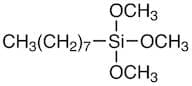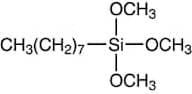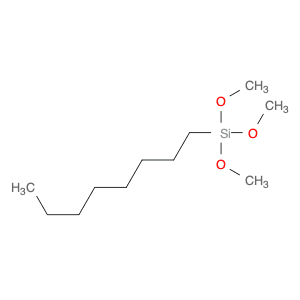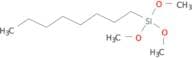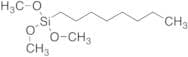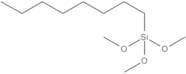
CAS 3069-40-7
:Octyltrimethoxysilane
- 1-(Trimethoxysilyl)octane
- Cg-N 813
- Dynasylan OCTMO
- Jh-N 318
- Kbm 3083
- Octyltrimethoxy silane
- Octyltrimethoxysilane
- Si 108
- Sil-Act ATS 100LV
- Sil-Act ATS 22
- Sil-Act ATS 42A
- Sil-Act ATS 42NS
- Silan 108
- Silane, trimethoxyoctyl-
- Sio 6715.5
- Trimethoxy(Octyl)Silane
- Trimethoxyoctylsilane
- Xc 95-738
- See more synonyms
Trimethoxy-n-octylsilane
CAS:Formula:C11H26O3SiPurity:>96.0%(GC)Color and Shape:Colorless to Almost colorless clear liquidMolecular weight:234.41n-Octyltrimethoxysilane, 97+%
CAS:n-Octyltrimethoxysilane is used in medicine field, electronic industry and polymer material. It is also used as surface modifier. This Thermo Scientific Chemicals brand product was originally part of the Alfa Aesar product portfolio. Some documentation and label information may refer to the legacy bFormula:C11H26O3SiPurity:97+%Color and Shape:Clear colorless to yellow, LiquidMolecular weight:234.41Trimethoxy(octyl)silane
CAS:Formula:C11H26O3SiPurity:96%Color and Shape:LiquidMolecular weight:234.4078n-Octyltrimethoxysilane
CAS:S12800 - n-Octyltrimethoxysilane
Formula:C11H26O3SiPurity:95%Color and Shape:Liquid, Clear LiquidMolecular weight:234.411Trimethoxy(octyl)silane
CAS:Controlled ProductApplications Trimethoxy(octyl)silane is a surface modifier used as additive for polymer encapsulation and for controlled drug delivery.
References Erdem, B., et al.: Langmuir, 17, 2664 (2001); Doadrio, J., et al.: J. Mater. Chem., 16, 462 (2006);Formula:C11H26O3SiColor and Shape:NeatMolecular weight:234.408n-OCTYLTRIMETHOXYSILANE
CAS:Alkyl Silane - Conventional Surface Bonding
Aliphatic, fluorinated aliphatic or substituted aromatic hydrocarbon substituents are the hydrophobic entities which enable silanes to induce surface hydrophobicity. The organic substitution of the silane must be non-polar. The hydrophobic effect of the organic substitution can be related to the free energy of transfer of hydrocarbon molecules from an aqueous phase to a homogeneous hydrocarbon phase. A successful hydrophobic coating must eliminate or mitigate hydrogen bonding and shield polar surfaces from interaction with water by creating a non-polar interphase. Although silane and silicone derived coatings are in general the most hydrophobic, they maintain a high degree of permeability to water vapor. This allows coatings to breathe and reduce deterioration at the coating interface associated with entrapped water. Since ions are not transported through non-polar silane and silicone coatings, they offer protection to composite structures ranging from pigmented coatings to rebar reinforced concrete. A selection guide for hydrophobic silanes can be found on pages 22-31 of the Hydrophobicity, Hydrophilicity and Silane Surface Modification brochure.
n-Octyltrimethoxysilane; Trimethoxysilyloctane
Viscosity: 1.0 cStVapor pressure, 75 °: 0.1 mmTreatment for particles used in non-aqueous liquid dispersionsTrialkoxy silaneFormula:C11H26O3SiPurity:97%Color and Shape:Straw LiquidMolecular weight:234.41Ref: 3H-SIO6715.5
Discontinued product