CAS 3085-76-5
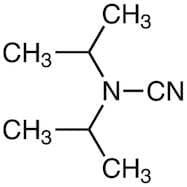
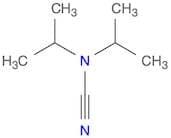
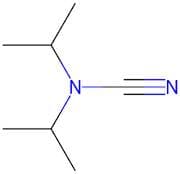
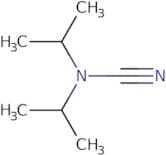
:N,N-Bis(1-methylethyl)cyanamide
Description:
N,N-Bis(1-methylethyl)cyanamide, also known by its CAS number 3085-76-5, is an organic compound characterized by its cyanamide functional group and two isopropyl groups attached to the nitrogen atoms. This substance typically appears as a colorless to pale yellow liquid or solid, depending on the temperature and purity. It is soluble in polar organic solvents but has limited solubility in water. The compound exhibits properties typical of cyanamides, including potential applications in agriculture as a herbicide or plant growth regulator. It may also serve as an intermediate in organic synthesis. Due to the presence of the cyanamide group, it can participate in various chemical reactions, such as condensation and substitution reactions. Safety considerations are important, as cyanamides can be toxic and may pose health risks upon exposure. Proper handling and storage conditions are essential to mitigate any hazards associated with this compound. Always refer to safety data sheets and regulatory guidelines when working with chemical substances.
Formula:C7H14N2
InChI:InChI=1S/C7H14N2/c1-6(2)9(5-8)7(3)4/h6-7H,1-4H3
InChI key:InChIKey=DGCUISYKMONQDH-UHFFFAOYSA-N
SMILES:N(C(C)C)(C(C)C)C#N
Synonyms:- Cyanamide, N,N-bis(1-methylethyl)-
- Cyanamide, bis(1-methylethyl)-
- Cyanamide, diisopropyl-
- Dipropan-2-Ylcyanamide
- N,N-Bis(1-methylethyl)cyanamide
- NSC 7775
- Diisopropylcyanamide
Sort by
Purity (%)
0
100
|
0
|
50
|
90
|
95
|
100
Found 5 products.
Diisopropylcyanamide
CAS:Formula:C7H14N2Purity:>98.0%(GC)Color and Shape:Colorless to Almost colorless clear liquidMolecular weight:126.20Diisopropylcyanamide
CAS:Diisopropylcyanamide is a labile organic solvent that reacts with triazine and pyridine compounds to form cyanuric acid. It is used as a crystallization solvent in the synthesis of various ligands, including growth factors. The compound has been shown to be thermally stable, reacting at temperatures up to 200°C under vacuum conditions. Diisopropylcyanamide can be synthesized by reacting an amine with hydrogen cyanide. This reaction takes place in an organic solvent such as chloroform or dichloromethane and requires heating for 2 hours at 60°C.
Formula:C7H14N2Purity:Min. 95%Molecular weight:126.2 g/mol