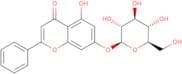
CAS 31025-53-3
:5-hydroxy-4-oxo-2-phenyl-4H-chromen-7-yl beta-D-glucopyranoside
Description:
5-Hydroxy-4-oxo-2-phenyl-4H-chromen-7-yl beta-D-glucopyranoside, with the CAS number 31025-53-3, is a glycosylated flavonoid compound. It features a chromone backbone, which is a bicyclic structure consisting of a benzene ring fused to a pyrone ring, and is substituted with a phenyl group and a hydroxyl group, contributing to its antioxidant properties. The beta-D-glucopyranoside moiety indicates that it is a glycoside, where a glucose unit is attached via a glycosidic bond, enhancing its solubility in water and biological activity. This compound is of interest in pharmacology and natural product chemistry due to its potential health benefits, including anti-inflammatory and antioxidant effects. Its structural characteristics allow it to interact with various biological targets, making it a subject of research in the development of therapeutic agents. Additionally, its stability and reactivity can be influenced by environmental factors such as pH and temperature, which are important considerations in its application and study.
Formula:C21H20O9
InChI:InChI=1/C21H20O9/c22-9-16-18(25)19(26)20(27)21(30-16)28-11-6-12(23)17-13(24)8-14(29-15(17)7-11)10-4-2-1-3-5-10/h1-8,16,18-23,25-27H,9H2/t16-,18-,19+,20-,21-/m1/s1
Synonyms:- 4H-1-Benzopyran-4-one, 7-(beta-D-glucopyranosyloxy)-5-hydroxy-2-phenyl-
Sort by
Purity (%)
0
100
|
0
|
50
|
90
|
95
|
100
Found 1 products.
Aequinetin
CAS:Aequinetin is a cyclic peptide, which is derived from marine organisms, specifically sponges. It acts by targeting cellular processes in bacteria and cancer cells through disruption of cell membrane integrity and interference with specific signaling pathways. This mode of action makes it a promising candidate for antibiotic and anticancer applications.Formula:C21H20O9Purity:Min. 95%Molecular weight:416.38 g/mol