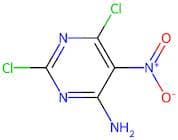
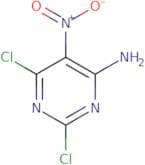
CAS 31221-68-8
:2,6-dichloro-5-nitropyrimidin-4-amine
Description:
2,6-Dichloro-5-nitropyrimidin-4-amine is a heterocyclic organic compound characterized by its pyrimidine ring, which contains two chlorine atoms and a nitro group as substituents. The presence of these functional groups contributes to its chemical reactivity and potential applications in various fields, including pharmaceuticals and agrochemicals. The compound typically exhibits moderate solubility in polar solvents due to the electronegative chlorine and nitro groups, which can also influence its biological activity. Its structure suggests that it may participate in nucleophilic substitution reactions, making it a candidate for further chemical modifications. Additionally, the compound's unique arrangement of substituents can affect its electronic properties, potentially leading to interesting optical characteristics. Safety data should be consulted, as halogenated compounds can pose environmental and health risks. Overall, 2,6-dichloro-5-nitropyrimidin-4-amine is a valuable compound in synthetic organic chemistry, with potential applications in drug development and agricultural chemistry.
Formula:C4H2Cl2N4O2
InChI:InChI=1/C4H2Cl2N4O2/c5-2-1(10(11)12)3(7)9-4(6)8-2/h(H2,7,8,9)
SMILES:c1(c(Cl)nc(Cl)[nH]c1=N)N(=O)=O
Sort by
Purity (%)
0
100
|
0
|
50
|
90
|
95
|
100
Found 4 products.
2,6-Dichloro-5-nitropyrimidin-4-amine
CAS:2,6-Dichloro-5-nitropyrimidin-4-aminePurity:95%Molecular weight:208.99g/mol2,6-Dichloro-5-nitropyrimidin-4-amine
CAS:2,6-Dichloro-5-nitropyrimidin-4-amine is a chlorinating agent that reacts with aliphatic and aromatic amines to form substituted pyrimidines. The substitution pattern of the product depends on the regioselectivity of the reaction. 2,6-Dichloro-5-nitropyrimidin-4-amine is one of the few chlorinating agents that react with propylamine. Substitution at position 2 of the purine ring has been found to be more selective than substitution at position 6. The 2,6-dichloropyrimidine can also be used as a nitro group source in chemical synthesis or as an intermediate in production of other compounds.
Formula:C4H2Cl2N4O2Purity:Min. 95%Color and Shape:SolidMolecular weight:208.99 g/molRef: 3D-FD141087
Discontinued product