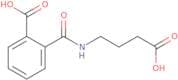
![2-[[(3-Carboxypropyl)amino]carbonyl]benzoic acid](/_next/image/?url=https%3A%2Fstatic.cymitquimica.com%2Fcas-image%2Fthumb-webp%2F107542-2-3-carboxypropyl-amino-carbonyl-benzoic-acid.webp&w=3840&q=75)
CAS 3130-76-5
:2-[[(3-Carboxypropyl)amino]carbonyl]benzoic acid
Description:
2-[[(3-Carboxypropyl)amino]carbonyl]benzoic acid, also known as a derivative of benzoic acid, features a carboxypropyl side chain and an amino group, contributing to its unique properties. This compound is characterized by its ability to form hydrogen bonds due to the presence of both carboxylic acid and amine functional groups, which can enhance its solubility in polar solvents. It typically exhibits acidic behavior, with the carboxylic acid group capable of donating protons in solution. The molecular structure suggests potential applications in pharmaceuticals, particularly as a building block in drug synthesis or as a biochemical probe. Additionally, its ability to interact with biological systems may make it relevant in studies of enzyme inhibition or receptor binding. The compound's stability and reactivity can be influenced by pH and temperature, which are important considerations in its handling and application. Overall, 2-[[(3-Carboxypropyl)amino]carbonyl]benzoic acid is a versatile compound with significant implications in both synthetic and biological chemistry.
Formula:C12H13NO5
InChI:InChI=1S/C12H13NO5/c14-10(15)6-3-7-13-11(16)8-4-1-2-5-9(8)12(17)18/h1-2,4-5H,3,6-7H2,(H,13,16)(H,14,15)(H,17,18)
InChI key:InChIKey=LENIZMSGCFPTBO-UHFFFAOYSA-N
SMILES:C(NCCCC(O)=O)(=O)C1=C(C(O)=O)C=CC=C1
Synonyms:- 2-(3-Carboxypropylcarbamoyl)benzoic acid
- 2-[[(3-Carboxypropyl)amino]carbonyl]benzoic acid
- Benzoic Acid, 2-[[(3-Carboxypropyl)Amino]Carbonyl]-
- N-Phthaloyl-γ-aminobutyric acid
- Phthalamic acid, N-(3-carboxypropyl)-
- 2-[(3-Carboxypropyl)carbamoyl]benzoic acid
Sort by
Purity (%)
0
100
|
0
|
50
|
90
|
95
|
100
Found 2 products.
N-(3-Carboxy-propyl)-phthalamic acid
CAS:3-Carboxy-propyl-phthalamic acid is a derivative of 3-mercaptopropionic acid. It has been shown to have ulceration properties in animals, and is currently undergoing clinical trials for the treatment of peptic ulcers. 3-Carboxy-propyl-phthalamic acid is also a potent inhibitor of tnf-α and has been shown to block the synthesis of this cytokine in animals. The anti inflammatory effects are due to its ability to inhibit the production of prostaglandins and leukotrienes. In addition, it blocks the binding of GABA to receptors and inhibits the activity of GABA transaminase. This compound may be used as an antinociceptive agent, but does not provide protection against convulsions or respiratory depression.Formula:C12H13NO5Purity:Min. 95%Molecular weight:251.23 g/mol