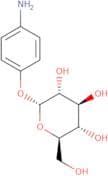
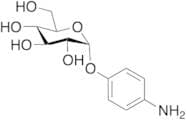
CAS 31302-52-0
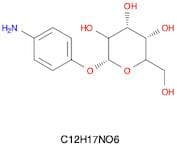
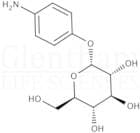
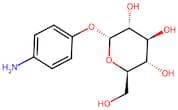
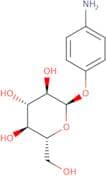
:4-aminophenyl-alpha-D-glucopyranoside
Description:
4-Aminophenyl-alpha-D-glucopyranoside is a chemical compound characterized by the presence of an amino group and a glucopyranoside moiety. It features a phenyl ring substituted with an amino group at the para position, which contributes to its potential biological activity. The glucopyranoside part indicates that it is a glycoside, specifically an alpha-D-glucopyranoside, meaning that the glucose unit is in its pyranose form and is linked to the phenyl group through a glycosidic bond. This compound is often studied for its applications in biochemistry and medicinal chemistry, particularly in the context of drug design and development. Its solubility in water and organic solvents can vary, influencing its bioavailability and interaction with biological systems. The presence of both hydrophilic (glucose) and hydrophobic (phenyl) components allows for diverse interactions, making it a subject of interest in research related to enzyme substrates and inhibitors. Overall, 4-aminophenyl-alpha-D-glucopyranoside exemplifies the intersection of carbohydrate chemistry and aromatic compounds, showcasing the complexity of molecular interactions in biological systems.
Sort by
Purity (%)
0
100
|
0
|
50
|
90
|
95
|
100
Found 6 products.
4-Aminophenyl a-D-glucopyranoside
CAS:Formula:C12H17NO6Purity:97%Color and Shape:SolidMolecular weight:271.26654-Aminophenyl α-D-glucopyranoside
CAS:4-Aminophenyl α-D-glucopyranosideColor and Shape:White SolidMolecular weight:271.27g/mol4-Aminophenyl-α-D-glucopyranoside
CAS:4-Aminophenyl-alpha-D-glucopyranoside is a natural product that has been found to be an antigen. The compound has been shown to have anticancer activity, which may be due to its ability to inhibit the growth of cells and induce apoptosis. 4-Aminophenyl-alpha-D-glucopyranoside also possesses magnetic properties. The chemical structure of this compound is characterized by an acrylate group, which is a small organic molecule with two carbon atoms and one oxygen atom. This compound is synthesized in a preparative manner using methoxy, ethyl bromoacetate, and mesitylene in the presence of irradiation. NMR spectroscopy can be used for the characterization of this compound as well as other compounds with similar structures that are catalytic in nature.Formula:C12H17NO6Purity:Min. 98.0 Area-%Molecular weight:271.27 g/mol4-Aminophenyl a-D-glucopyranoside
CAS:4-Aminophenyl a-D-glucopyranoside is an alkoxycarbonyl analog that can be used in the preparation of antigens. It is a small, water-soluble molecule that can be used to induce antibody production and to identify antigenic determinants. 4-Aminophenyl a-D-glucopyranoside has been shown to react with glutamicum and corynebacterium cells in vitro. The compound binds to the bacterial cell surface by reacting with amino groups, inducing the production of acid molecules, which leads to bacterial death. 4-Aminophenyl a-D-glucopyranoside also reacts with methoxy residues on the ribosomal RNA molecule and corynebacterium DNA molecules. This allows it to be used as an expression vector for proteins and nucleic acids in Corynebacterium glutamicum (a bacterium commonly found in soil). SpectroscFormula:C12H17NO6Purity:Min. 95%Color and Shape:PowderMolecular weight:271.27 g/mol4-Aminophenyl a-D-Glucopyranoside
CAS:Controlled ProductApplications 4-Aminophenyl α-D-Glucopyranoside is a glycoside derivative of 4-Aminophenol (A618920); a nephrotoxic metabolite of Acetaminophen (A161220) and Phenacetin (P294580) (1).
References (1) Watanabe, et al.: Drug Metab. Dispos., 38, 1532 (2010)Formula:C12H17NO6Color and Shape:NeatMolecular weight:271.27