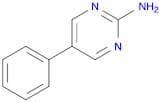
CAS 31408-23-8
:2-Pyrimidinamine, 5-phenyl-
Description:
2-Pyrimidinamine, 5-phenyl- is an organic compound characterized by its pyrimidine ring structure, which is a six-membered heterocyclic aromatic ring containing two nitrogen atoms at positions 1 and 3. This compound features an amino group (-NH2) at the 2-position and a phenyl group (a benzene ring) at the 5-position of the pyrimidine ring, contributing to its unique chemical properties. It is typically a solid at room temperature and may exhibit moderate solubility in polar solvents due to the presence of the amino group, which can engage in hydrogen bonding. The compound may participate in various chemical reactions, including nucleophilic substitutions and coupling reactions, making it of interest in medicinal chemistry and organic synthesis. Its structural characteristics suggest potential applications in pharmaceuticals, particularly in the development of compounds targeting specific biological pathways. As with many nitrogen-containing heterocycles, it may also exhibit interesting electronic properties, influencing its reactivity and interaction with other chemical species.
Formula:C10H9N3
Sort by
Purity (%)
0
100
|
0
|
50
|
90
|
95
|
100
Found 4 products.
2-Pyrimidinamine, 5-Phenyl- (9CI)
CAS:Formula:C10H9N3Purity:97%Color and Shape:SolidMolecular weight:171.19865-Phenylpyrimidin-2-amine
CAS:5-Phenylpyrimidin-2-amine is a synthetic chemical that is an intermediate in the production of other chemicals. It can be used to produce sulfate, nucleophilic amines, or active methylene compounds. 5-Phenylpyrimidin-2-amine can also be used as a starting material for the production of triethyloxonium chloride and 13C NMR spectroscopy reagents. 5-Phenylpyrimidin-2-amine has a nucleophilic nature and is capable of reacting with a variety of functional groups. This chemical can undergo demethylation reactions with sulfate, chlorides, and cyanamide, which are all reactive with the methyl group on this chemical. 5-Phenylpyrimidin-2-amine is an isomeric compound that exists in two forms: one with substituents at positions 2 and 6 (syn) and one with substituents at positions 3Formula:C10H9N3Purity:Min. 95%Molecular weight:171.2 g/mol