CAS 31542-62-8
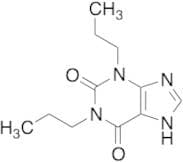
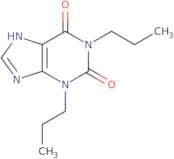
:1,3-dipropyl-3,7-dihydro-1H-purine-2,6-dione
Description:
1,3-Dipropyl-3,7-dihydro-1H-purine-2,6-dione, commonly known as theophylline derivative, is a purine-based compound characterized by its structure, which includes a purine ring with two propyl groups attached at the 1 and 3 positions. This compound exhibits properties typical of xanthine derivatives, including stimulant effects on the central nervous system and bronchodilation, making it relevant in pharmacology, particularly in respiratory therapies. It is a white to off-white crystalline solid that is soluble in water and organic solvents, reflecting its polar nature due to the presence of carbonyl groups. The compound's melting point and boiling point can vary based on purity and environmental conditions. Its chemical behavior is influenced by the presence of functional groups, allowing it to participate in various chemical reactions, including methylation and oxidation. As a derivative of theophylline, it may also exhibit similar pharmacokinetic properties, such as metabolism by cytochrome P450 enzymes. Overall, 1,3-dipropyl-3,7-dihydro-1H-purine-2,6-dione is of interest in medicinal chemistry for its potential therapeutic applications.
Formula:C11H16N4O2
InChI:InChI=1/C11H16N4O2/c1-3-5-14-9-8(12-7-13-9)10(16)15(6-4-2)11(14)17/h7H,3-6H2,1-2H3,(H,12,13)
SMILES:CCCn1c2c(c(=O)n(CCC)c1=O)nc[nH]2
Synonyms:- 1,3-dipropyl-3,9-dihydro-1H-purine-2,6-dione
- 1H-purine-2,6-dione, 3,7-dihydro-1,3-dipropyl-
- 1H-purine-2,6-dione, 3,9-dihydro-1,3-dipropyl-
Sort by
Purity (%)
0
100
|
0
|
50
|
90
|
95
|
100
Found 2 products.
1,3-Dipropylxanthine
CAS:Controlled ProductApplications A phosphodiesterase inhibitor and caffeine analog with some selectivity for A2 adenosine receptors. UV lmax = 273 nm, log e=3.98.
References Life Sci., 39, 743 (1986); J. Pharmacol. Exp. Ther., 242, 882 (1987); Life Sci., 43, 387 (1988)Formula:C11H18N4O2Color and Shape:NeatMolecular weight:238.291,3-Dipropylxanthine
CAS:Controlled Product1,3-Dipropylxanthine is a congener of caffeine. It is a nonselective adenosine receptor antagonist that binds to the adenosine receptors in the kidney. 1,3-Dipropylxanthine has been shown to increase renal blood flow and increase urine output. This drug may be used as a mobilisation agent for patients who are bedridden or have limited mobility. It should not be given to patients with heart disease or high blood pressure. 1,3-Dipropylxanthine has also been shown to inhibit the binding of pyrimido [1,2-a]benzimidazole (PPIM) and furyl derivatives to the adenosine receptor.Formula:C11H16N4O2Purity:Min. 95%Color and Shape:PowderMolecular weight:236.27 g/mol