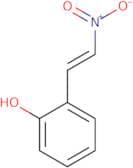
CAS 3156-43-2
:2-(2-nitroethenyl)phenol
Description:
2-(2-Nitroethenyl)phenol, with the CAS number 3156-43-2, is an organic compound characterized by its phenolic structure and a nitroethenyl substituent. This compound typically appears as a solid at room temperature and is known for its potential applications in organic synthesis and as an intermediate in the production of various chemical products. The presence of the nitro group contributes to its reactivity, making it a candidate for electrophilic substitution reactions. Additionally, the phenolic hydroxyl group can participate in hydrogen bonding, influencing its solubility and interaction with other substances. The compound may exhibit specific optical properties due to its conjugated system, which can be relevant in photochemical applications. Safety data should be consulted, as nitro compounds can be hazardous, and appropriate handling procedures should be followed. Overall, 2-(2-nitroethenyl)phenol is a notable compound in the realm of organic chemistry, with unique characteristics stemming from its functional groups.
Formula:C8H7NO3
InChI:InChI=1/C8H7NO3/c10-8-4-2-1-3-7(8)5-6-9(11)12/h1-6,10H
SMILES:c1ccc(c(c1)C=CN(=O)=O)O
Sort by
Purity (%)
0
100
|
0
|
50
|
90
|
95
|
100
Found 2 products.
1-(2-Hydroxyphenyl)-2-nitroethene
CAS:<p>1-(2-Hydroxyphenyl)-2-nitroethene is an organocatalytic biomolecule that has been synthesized in an asymmetric fashion. The synthesis of the molecule relies on a squaramide and the use of intramolecular hydrogen transfer reactions to create a nitro group. The molecule was used to generate antiestrogenic activity in MDA-MB-231 breast cancer cells and MCF-7 breast cancer cells by inhibiting estrogen receptor alpha (ERα) transcriptional activity. This molecule has also been shown to be bifunctional, as it inhibits both protein kinase C (PKC) and mitogen-activated protein kinase (MAPK) signaling pathways when applied to these cell lines. X-ray crystal structures of the molecule have been obtained with orientations that exhibit different degrees of hydrophobicity, which may be due to interactions with water molecules.</p>Formula:C8H7NO3Purity:Min. 95%Molecular weight:165.15 g/molRef: 3D-FH65831
Discontinued product