![3,9-dimethoxy-6H-[1]benzofuro[3,2-c]chromen-6-one](/_next/image/?url=https%3A%2Fstatic.cymitquimica.com%2Fcas-image%2Fthumb-webp%2F174987-39-dimethoxy-6h-1-benzofuro-32-c-chromen-6-one.webp&w=3840&q=75)
CAS 3172-99-4
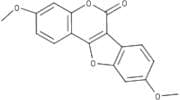
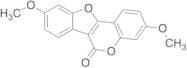
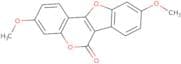
:3,9-dimethoxy-6H-[1]benzofuro[3,2-c]chromen-6-one
Description:
3,9-Dimethoxy-6H-[1]benzofuro[3,2-c]chromen-6-one, with the CAS number 3172-99-4, is a synthetic organic compound that belongs to the class of flavonoids, specifically a chromone derivative. This compound features a complex polycyclic structure that includes a benzofuran moiety fused to a chromone ring, which contributes to its unique chemical properties. The presence of two methoxy groups at the 3 and 9 positions enhances its solubility and may influence its biological activity. Typically, compounds of this nature exhibit a range of pharmacological properties, including antioxidant, anti-inflammatory, and potential anticancer activities, making them of interest in medicinal chemistry. The compound's molecular structure allows for various interactions with biological targets, which can be explored in drug development. Additionally, its stability and reactivity can be influenced by the methoxy substituents, affecting its behavior in different chemical environments. Overall, 3,9-dimethoxy-6H-[1]benzofuro[3,2-c]chromen-6-one represents a fascinating area of study within organic and medicinal chemistry.
Formula:C17H12O5
InChI:InChI=1/C17H12O5/c1-19-9-3-5-11-13(7-9)21-16-12-6-4-10(20-2)8-14(12)22-17(18)15(11)16/h3-8H,1-2H3
SMILES:COc1ccc2c(c1)oc1c3ccc(cc3oc(=O)c21)OC
Sort by
Purity (%)
0
100
|
0
|
50
|
90
|
95
|
100
Found 3 products.
Coumestrol dimethylether
CAS:Coumestrol dimethylether analytical standard provided with w/w absolute assay, to be used for quantitative titration.Formula:C17H12O5Purity:(HPLC) ≥98%Color and Shape:PowderMolecular weight:296.28Coumestrol dimethyl ether
CAS:Controlled ProductFormula:C17H12O5Color and Shape:NeatMolecular weight:296.273,9-Di-O-methylcoumestrol
CAS:3,9-Di-O-methylcoumestrol is a synthetic coumestan derivative, which is primarily derived or synthesized from various plant sources that produce isoflavonoids and related compounds. As a type of phytoestrogen, it exhibits selective estrogen receptor modulating activity, interacting with estrogen receptors in a manner similar to endogenous hormones but with distinctive affinity and specificity. This mode of action suggests it could influence estrogen-responsive pathways, making it of particular interest in fields like endocrinology and pharmacology.
Formula:C17H12O5Purity:Min. 95%Molecular weight:296.27 g/molRef: 3D-FD69720
Discontinued product