CAS 31729-66-5
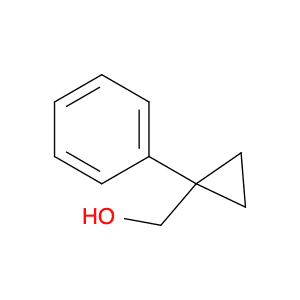
:1-Phenylcyclopropanemethanol
Description:
1-Phenylcyclopropanemethanol, with the CAS number 31729-66-5, is an organic compound characterized by its unique cyclopropane structure fused with a phenyl group and a hydroxymethyl functional group. This compound typically appears as a colorless to pale yellow liquid and exhibits a relatively low boiling point, indicative of its small molecular size. The presence of the hydroxymethyl group contributes to its potential reactivity, allowing for various chemical transformations, such as oxidation or substitution reactions. Additionally, the phenyl group enhances the compound's stability and can influence its solubility in organic solvents. 1-Phenylcyclopropanemethanol may also exhibit interesting biological activities, making it a subject of interest in medicinal chemistry. Its structural features suggest potential applications in the synthesis of more complex molecules or as intermediates in organic synthesis. Overall, the compound's unique structure and functional groups provide a foundation for further exploration in both academic and industrial chemistry contexts.
Formula:C10H12O
InChI:InChI=1/C10H12O/c11-8-10(6-7-10)9-4-2-1-3-5-9/h1-5,11H,6-8H2
InChI key:InChIKey=APALRPYIDIBHQN-UHFFFAOYSA-N
SMILES:C(O)C1(CC1)C2=CC=CC=C2
Synonyms:- (1-Phenylcyclopropyl)Methanol
- 1-Phenyl-1-(hydroxymethyl)cyclopropane
- 1-Phenyl-1-cyclopropanemethanol
- Brn 2501089
- Cyclopropanemethanol, 1-phenyl-
- 1-Phenylcyclopropanemethanol
- 4-06-00-03850 (Beilstein Handbook Reference)
- 1-Phenylcyclopropanemethanol
Sort by
Purity (%)
0
100
|
0
|
50
|
90
|
95
|
100
Found 4 products.
(1-Phenylcyclopropyl)methanol
CAS:Formula:C10H12OPurity:98%Color and Shape:LiquidMolecular weight:148.2017(1-Phenylcyclopropyl)methanol
CAS:(1-Phenylcyclopropyl)methanolPurity:98%Molecular weight:148.20g/mol(1-Phenylcyclopropyl)methanol
CAS:(1-Phenylcyclopropyl)methanol is an aromatic ketone that can be used in the synthesis of oxazaborolidines. It has been proven to be a good substrate for asymmetric syntheses, which are often used for the development of enantioselective reactions. The mechanism of this reaction is not yet fully understood, but it is thought that the C-O bond in (1-phenylcyclopropyl)methanol reacts with acetophenone to form an intermediate diketone. This intermediate then reacts with an electrophile such as sodium methoxide or methyl iodide to produce the desired product.
Formula:C10H12OPurity:Min. 95%Molecular weight:148.2 g/mol