CAS 3202-84-4
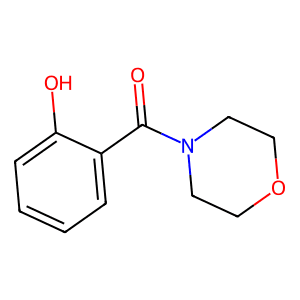
:(2-hydroxyphenyl)(morpholin-4-yl)methanone
Description:
(2-hydroxyphenyl)(morpholin-4-yl)methanone, also known by its CAS number 3202-84-4, is an organic compound characterized by the presence of a phenolic hydroxyl group and a morpholine ring. This compound typically exhibits properties associated with both aromatic and heterocyclic structures, contributing to its potential biological activity. The hydroxyl group enhances its solubility in polar solvents and can participate in hydrogen bonding, which may influence its reactivity and interaction with biological targets. The morpholine moiety adds to its structural complexity and may impart specific pharmacological properties. This compound is often studied for its potential applications in medicinal chemistry, particularly in the development of pharmaceuticals due to its ability to interact with various biological pathways. Its stability, reactivity, and solubility can vary based on environmental conditions, such as pH and temperature. Overall, (2-hydroxyphenyl)(morpholin-4-yl)methanone represents a versatile scaffold in organic synthesis and drug development.
Formula:C11H13NO3
InChI:InChI=1/C11H13NO3/c13-10-4-2-1-3-9(10)11(14)12-5-7-15-8-6-12/h1-4,13H,5-8H2
SMILES:c1ccc(c(c1)C(=O)N1CCOCC1)O
Synonyms:- 2-(Morpholin-4-Ylcarbonyl)Phenol
- 3202-84-4
- 4-Salicyloylmorpholine
- Methanone, (2-hydroxyphenyl)-4-morpholinyl-
- Morpholine, 4- (2-hydroxybenzoyl)-
- Morpholine, 4-salicyloyl-
- Salicyl Morpholide
- Tardisal
- (2-Hydroxyphenyl)(morpholin-4-yl)methanone
Sort by
Purity (%)
0
100
|
0
|
50
|
90
|
95
|
100
Found 3 products.
2-(Morpholine-4-carbonyl)phenol
CAS:2-(Morpholine-4-carbonyl)phenolPurity:97%Molecular weight:207.23g/molRef: 10-F657712
1g297.00€5g811.00€10g1,126.00€2.5g557.00€50mg71.00€100mg94.00€250mg119.00€500mg218.00€2-(Morpholine-4-carbonyl)phenol
CAS:2-(Morpholine-4-carbonyl)phenol is a rotenoid compound that has been shown to be a potent dehydrating agent. It readily reacts with amide and alkoxy radicals, cyclic alkali metal ions, and peptides. 2-(Morpholine-4-carbonyl)phenol can also react with chloride ions to form an unstable chloro radical. This reaction releases hydrogen chloride in the process and may result in the formation of carcinogenic nitro compounds. 2-(Morpholine-4-carbonyl)phenol has antiinflammatory activity and is used as an antimicrobial agent.Formula:C11H13NO3Purity:Min. 95%Molecular weight:207.23 g/mol