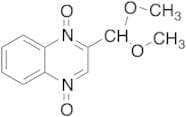
CAS 32065-66-0
:Quinoxaline, 2-(dimethoxymethyl)-, 1,4-dioxide
Description:
Quinoxaline, 2-(dimethoxymethyl)-, 1,4-dioxide, with CAS number 32065-66-0, is a heterocyclic organic compound characterized by its quinoxaline core, which consists of a fused bicyclic structure containing two nitrogen atoms. This compound features a dimethoxymethyl substituent at the 2-position, contributing to its unique chemical properties. The presence of the 1,4-dioxide functional group indicates that it has two oxygen atoms incorporated into the quinoxaline ring, enhancing its reactivity and potential applications. Quinoxaline derivatives are known for their biological activities, including antimicrobial and antitumor properties, making them of interest in medicinal chemistry. The dimethoxymethyl group may influence the compound's solubility and interaction with biological targets. Overall, this compound's structural features suggest it could be valuable in pharmaceutical research and development, although specific applications would depend on further studies of its biological activity and chemical behavior.
Formula:C11H12N2O4
InChI:InChI=1S/C11H12N2O4/c1-16-11(17-2)10-7-12(14)8-5-3-4-6-9(8)13(10)15/h3-7,11H,1-2H3
InChI key:InChIKey=BWTLITYWRKJWIM-UHFFFAOYSA-N
SMILES:O=N=1C2=C(N(=O)=CC1C(OC)OC)C=CC=C2
Synonyms:- 2-Formylquinoxaline 1,4-dioxide dimethyl acetal
- 2-Quinoxalinecarboxaldehyde 1,4-dioxide dimethyl acetal
- 2-Quinoxalinecarboxaldehyde, dimethyl acetal, 1,4-dioxide
- 3-(dimethoxymethyl)-1-oxoquinoxalin-1-ium-4(1H)-olate
- Quinoxaline, 2-(dimethoxymethyl)-, 1,4-dioxide
- Quinoxaline-2-carboxaldehyde dimethyl acetal di-N-oxide
- 2-(Dimethoxymethyl)quinoxaline 1,4-dioxide
Sort by
The purity filter is not visible because current products do not have associated purity data for filtering.
Found 2 products.
2-Quinoxalinecarboxaldehyde 1,4-Dioxide Dimethyl Acetal
CAS:Controlled ProductApplications 2-Quinoxalinecarboxaldehyde 1,4-Dioxide Dimethyl Acetal is an intermediate in the synthesis of Cyadox which is an antibiotic drug and has the potential to be used as a feedstuff additive in promoting the growth of animals.
References Huang, C., et al.: J. Proteome, Res. 4, 537 (2013); Wu, H.X., et al.: J. Pharma. Biomed. Anal., 67, 175 (2012);Formula:C14H9ClO3Color and Shape:NeatMolecular weight:260.673