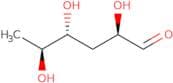
CAS 32142-24-8
:3,6-Dideoxy-L-arabino-hexose
Description:
3,6-Dideoxy-L-arabino-hexose is a monosaccharide characterized by its unique structure, which includes six carbon atoms and two hydroxyl groups, making it a hexose sugar. This compound is a derivative of L-arabinose, with the specific modification of having two hydroxyl groups replaced by hydrogen atoms at the 3 and 6 positions, resulting in a dideoxy configuration. It is typically found in certain natural products and can play a role in biological systems, particularly in the context of glycosylation reactions. The presence of the dideoxy configuration influences its reactivity and interactions with other biomolecules. In terms of solubility, like many sugars, it is generally soluble in water, which is a common characteristic of carbohydrates. Its structural features may also contribute to its potential applications in pharmaceuticals and biochemistry, particularly in the synthesis of glycosides or as a building block in the development of more complex carbohydrate structures. Overall, 3,6-Dideoxy-L-arabino-hexose is an important compound in the study of carbohydrate chemistry and its biological implications.
Formula:C6H12O4
InChI:InChI=1S/C6H12O4/c1-4(8)6(10)2-5(9)3-7/h3-6,8-10H,2H2,1H3/t4-,5+,6+/m0/s1
InChI key:InChIKey=GNTQICZXQYZQNE-KVQBGUIXSA-N
SMILES:C([C@H]([C@H](C)O)O)[C@H](C=O)O
Synonyms:- 3,6-Dideoxy-<span class="text-smallcaps">L</span>-arabino-hexose
- 3,6-Dideoxy-L-galactose
- <span class="text-smallcaps">L</span>-arabino-Hexose, 3,6-dideoxy-
- Ascarylose
- L-arabino-Hexose, 3,6-dideoxy-
- 3,6-Dideoxy-L-arabino-hexose
Sort by
Purity (%)
0
100
|
0
|
50
|
90
|
95
|
100
Found 1 products.
3,6-Dideoxy-L-arabino-hexose
CAS:3,6-Dideoxy-L-arabino-hexose (3,6-D) is a natural compound that has been shown to inhibit the growth of bacteria by binding to their ribosomes. It is an active inhibitor of tyvelose, which is a drug used in the treatment of infectious diseases. 3,6-D binds reversibly to the terminal residues on the bacterial ribosome and blocks the entry of tyvelose into the ribosome. The conformational properties of 3,6-D have been studied using hybridoma cell lines and methyl glycosides. Structural analysis has shown that 3,6-D may be synthesized from glucose in a series of enzymatic reactions involving glycan synthesis.Purity:Min. 95%