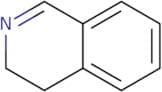
CAS 3230-65-7
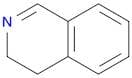
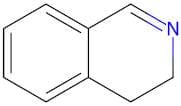
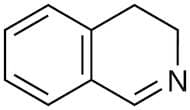
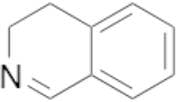
:3,4-Dihydroisoquinoline
Description:
3,4-Dihydroisoquinoline is a bicyclic organic compound characterized by its fused isoquinoline structure, which consists of a benzene ring fused to a pyridine ring. It is a colorless to pale yellow liquid at room temperature and has a distinctive aromatic odor. The compound is known for its role as an intermediate in the synthesis of various pharmaceuticals and bioactive molecules. Its molecular formula is C9H9N, indicating the presence of nine carbon atoms, nine hydrogen atoms, and one nitrogen atom. 3,4-Dihydroisoquinoline exhibits moderate solubility in organic solvents such as ethanol and ether, while being less soluble in water. The compound can undergo various chemical reactions, including oxidation and hydrogenation, making it a versatile building block in organic synthesis. Additionally, it has been studied for its potential biological activities, including neuroprotective and anti-inflammatory properties. Safety data suggests that, like many organic compounds, it should be handled with care to avoid inhalation or skin contact.
Formula:C9H9N
InChI:InChI=1S/C9H9N/c1-2-4-9-7-10-6-5-8(9)3-1/h1-4,7H,5-6H2
InChI key:InChIKey=NKSZCPBUWGZONP-UHFFFAOYSA-N
SMILES:C=12C(=CC=CC1)C=NCC2
Synonyms:- G 1616
- Isoquinoline, 3,4-dihydro-
- NSC 3007
- 3,4-Dihydroisoquinoline
Sort by
Purity (%)
0
100
|
0
|
50
|
90
|
95
|
100
Found 6 products.
3,4-Dihydroisoquinoline
CAS:Formula:C9H9NPurity:>95.0%(T)(HPLC)Color and Shape:White to Light yellow powder to lumpMolecular weight:131.183,4-Dihydroisoquinoline
CAS:Controlled ProductFormula:C9H9NColor and Shape:NeatMolecular weight:131.1743,4-Dihydroisoquinoline
CAS:3,4-Dihydroisoquinoline is a heterocyclic compound that is used as an anti-inflammatory agent and has been shown to inhibit the production of prostaglandins. 3,4-Dihydroisoquinoline decreases the immune response in animals with autoimmune diseases. This drug also inhibits tumor cell growth in vitro and in vivo. 3,4-Dihydroisoquinoline has been shown to be effective against cervical cancer cells, adrenocortical carcinoma cells, and cancer cells from lymphocytic leukemia. In addition, 3,4-dihydroisoquinoline causes apoptosis by inhibiting protein synthesis through its inhibition of DNA gyrase and topoisomerase IV.Formula:C9H9NPurity:Min. 95%Molecular weight:131.17 g/mol