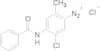
CAS 32348-81-5
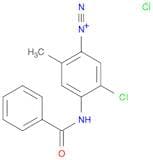
:Fast red violet LB salt
Description:
Fast Red Violet LB salt, with the CAS number 32348-81-5, is a synthetic azo dye commonly used in various applications, including textiles, food, and cosmetics. This compound is characterized by its vibrant red-violet color, which is attributed to the presence of azo functional groups (-N=N-). It exhibits good solubility in water, making it suitable for use in aqueous solutions. Fast Red Violet LB salt is known for its stability under normal conditions, although it may be sensitive to light and heat, which can affect its color intensity over time. The dye is often evaluated for its safety and environmental impact, as some azo dyes can release aromatic amines upon degradation, which may pose health risks. Therefore, regulatory guidelines often govern its use in consumer products. Overall, Fast Red Violet LB salt is valued for its coloring properties, but its application must be managed with consideration of safety and environmental factors.
Formula:C14H11Cl2N3O
InChI:InChI=1/C14H10ClN3O.ClH/c1-9-7-13(11(15)8-12(9)18-16)17-14(19)10-5-3-2-4-6-10;/h2-8H,1H3;1H
SMILES:CC1=CC(=NC(=O)c2ccccc2)C(=CC1=[N+]=[NH-])Cl.Cl
Sort by
Purity (%)
0
100
|
0
|
50
|
90
|
95
|
100
Found 4 products.
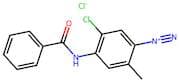
Fast Red Violet LB Salt
CAS:Formula:C14H11Cl2N3OPurity:95%Color and Shape:SolidMolecular weight:308.1626Fast Red Violet LB salt
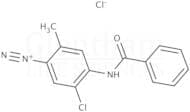
CAS:Formula:C14H11Cl2N3OZnCl2Color and Shape:Pale orange powderMolecular weight:376.31Fast red violet LB salt (Zn salt)
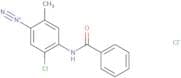
CAS:Fast Red Violet LB Salt is a dye that belongs to the class of natural compounds. The dye, which is also known as carminic acid, is extracted from the scales of female cochineal insects. Fast Red Violet LB Salt has been shown to have an inhibitory effect on osteoclasts and radiation-induced bone loss in animal models. This compound may be useful for treating metabolic disorders such as diabetes and autoimmune diseases. Fast Red Violet LB Salt has also been shown to increase the production of dinucleotide phosphate in cells and stimulate cell lysis in tissue culture experiments.Formula:C14H11Cl2N3OZnCl2Purity:Min. 95%Color and Shape:PowderMolecular weight:376.31 g/mol